
Introduction to Care Plans
Introduction to Care Plans
Author: Mark Parkinson BsPharm: President AFC-CE
Credit Hours 1 - Approximate time required: 60 min.
Educational Goal:
Tell In-Home caregivers how to use Care plans.
Educational Objectives:
- Tell Caregivers what care plans are.
- Explain the different purposes of care plans
- Tell how to write care plans.
- Provide examples of care plans.
- Instruct how to use the different types of care plans.
Procedure:
Read the course materials. 2. Click on exam portal [Take Exam]. 3. If you have not done so yet fill in Register form (username must be the name you want on your CE certificate). 4. Log in 5. Take exam. 6. Click on [Show Results] when done and follow the instructions that appear. 7. A score of 70% or better is considered passing and a Certificate of Completion will be generated for your records.
Disclaimer
The information presented in this activity is not meant contraindications may be of concern. All applicable manufacturers’ product information should be reviewed before use. The author and publisher of this continuing education program have made all reasonable efforts to ensure that all information contained herein is accurate in accordance with the latest available scientific knowledge at the time of acceptance for publication. Nutritional products discussed are not intended for the diagnosis, treatment, cure, or prevention of any disease.to serve as a guideline for patient management. All procedures, medications, or other courses of diagnosis or treatment discussed or suggested in this article should not be used by care providers without evaluation of their patients’ Doctor. Some conditions and possible
Introduction to Care Plans
There has been a growing recognition of the need for better communication and planning in caregiving. To address this issue, many medical professions have started to implement a program of formal care plans that provide a framework for how care is provided. Government oversight has recognized the value of these efforts and has started to mandate the use of care plans. So, could you benefit from a Care Plan for your residents? Hopefully, by the end of this lesson, you will be able to answer that question for yourself. Let us start off with- what is a care plan?
Definition – Care plan
The Centers for Disease Control and Prevention defines a Care Plan as:
“A care plan is a form where you can summarize a person's health conditions, specific care needs, and current treatments.
Care plans can help:
- Keep important caregiving information in one place.
- To organize and prioritize caregiving activities.
- Give a sense of control and confidence when managing caregiving tasks.
- Assure that the care recipient's needs are being met.
- To ensure consistent care when transitioning caregivers.”
Care plans can be especially helpful if you care for more than one person.”
You can see the CDC care plan form here. https://www.cdc.gov/caregiving/media/pdfs/Complete-Care-Plan-Form-5081.pdf
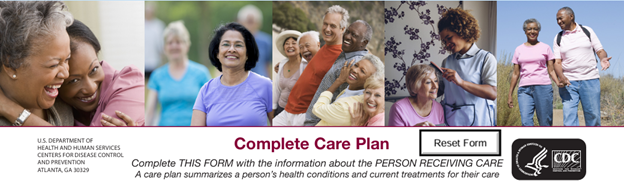
There are many different types of care plans. They can be simple to very complex. It all depends on what is needed and who needs to be involved.
Other examples of care plans are here; just click the links.
https://printblame.com/health/nurses/nursing-care-plans/
https://inkpx.com/templates/6olv/printable-simple-minimalist-student-nursing-care-plan-template
 |
I know what some of you are thinking.
Oh really!? Are you so sure about that? Let’s take a closer look, shall we?
|
- If you have a business and are doing the same things over and over, you have been operating from a care plan. It’s just not on paper, it’s in your head. You have been using a mental care plan since you took on your first client. You know your people, and you have goals that you are working towards. So it's just a matter of thinking about what you have been doing and writing it down in a care plan format.
- When a client moves into your home, you become responsible for just about everything. You become the focal point between family, the medical community, government, and society in general. You have to communicate and coordinate with --- everyone. A care plan makes that easier.
- How do you know if you are doing a good job at caregiving if you don’t have a baseline to compare your performance to? If there is a complaint, a government investigation, or heaven forbid a lawsuit, it’s just your word against whoever is against you. No proof, no records, no safeguards. A written care plan is your proof and protection.
|
Care plans are another caregiver tool that will help you be more professional and, if used correctly, make your job easier. Worth it? In my opinion, yes- worth it! So let’s get after it. Care plan, ready, set, go! |
 |
Let the Purpose Guide You
There is no “One Size Fits All” format for Care plans. In my research, I found a dizzying variety in the formats and content in the examples I saw. Then it struck me, the Care Plans were different because each had a different purpose. Naturally, a Nursing Home care plan would be different from a Nursing care plan. Similarly, a Nursing home care plan with a large staff of different medical professionals that need coordinating would be different from an Adult Foster Care home with just a few employees. So the first step in writing your care plan is determining the purpose of your care plan. What are you trying to accomplish with it?
- Are you trying to keep track of multiple doctors and therapies?
- Are you going to use it as a single source for all patient info that can be used for doctor visits, hospital stays, home health nurse, etc? A patient file sort of thing.
- Are you going to use it to smooth the transition of new clients? Examples: What are your allergies, what’s your favorite foods, what religion are you?
- Is it going to be used as training material for new caregiver hires?
- What regulation or restriction do you have to comply with?
- Etc Etc Etc.
Building a Care Plan
So what caregiving and business elements are important to you? If nothing comes to mind, start asking yourself some questions.
- What are the issues that continually crop up that need to be addressed?
- Who is always looking over your shoulder to see what you’re doing, and why do they want to see?
- Are verbal instructions always followed? Do they need to be written down?
- What seems to be always forgotten about?
- Are your records all over the place and cumbersome? Do they need streamlining?
- Is caregiving becoming very burdensome to you? Are your residents happy?
- Are attending medical professionals, government inspectors, or family members annoying you and getting in your way? Or are they helping you, and you want them there for their input?
- Are there any regulations that have to be complied with?
To sum all of the above up, where’s the need, and how do you build your care plan to meet that need? Here are a few examples

Reporting Tool
Need- You have a resident who has a complicated medical condition(s). The Doctor or Home Health Nurse has to have frequent reports to judge the effect of therapy.
Steven Johnson
|
Health Problem |
Goal of Care |
Intervention |
Out Come |
|
Sedentary lifestyle due to pain in the legs |
Increase mobility and decrease the level of pain |
Control Diabetes, Establish a regular exercise program, and develop a pain medicine regimen |
Diabetes is controlled but pain continues at levels 6-8. Patient refuses to get up and move about. |
Patient File Tool
Review the CDC form again by clicking here.
chrome- extension://efaidnbmnnnibpcajpcglclefindmkaj/https://www.cdc.gov/caregiving/media/pdfs/Complete-Care-Plan-Form-5081.pdf
Fair warning, there will be some quiz questions about what's on the form.
Here is a shortcut suggestion. Can you take your current patient information filing system and make a few tweaks to turn it into a Care Plan? For instance, instead of just recording basic information, add some forward-looking sections as they have in the CDC form.
Mary Ann Webster
In a few sentences, tell people what you want them to know about you.
|
I have an allergy to strawberries. I like to take walks. I need to watch church services on Sunday. I have fallen twice while going to the bathroom at night. |
Baseline and Outcome Tool
This could also be called a Goals and Outcome Tool. The idea is to gather data about a patient's behavior or condition. Then, with the help of the doctor or other medical professional, determine what therapies and outcomes are desired. Next, track the progress toward the goal. This could also be used for non-medical aspects like overall contentment. In these cases, you would get the help of family members or church groups. Since you are tracking outcomes, it would be helpful if you could measure something. For example, on a scale of 1-10, 10 being the best, how content do you feel?
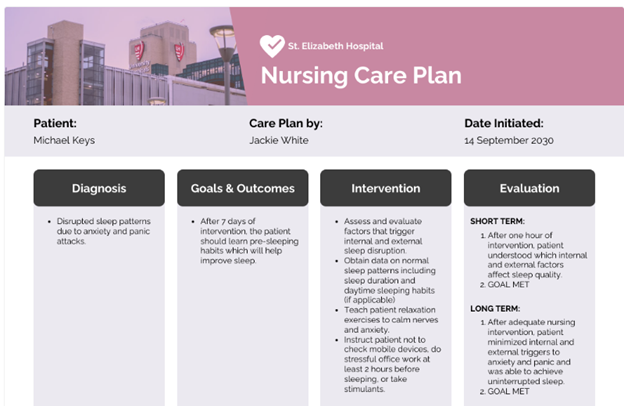
Training Tool
The main caregiver quickly establishes a routine that works well. But when a new hire or substitute caregiver gets involved, then a care plan is a very useful tool in getting them up to speed quickly. When I ran my own Adult Foster Care homes, we had a laminated chore list that the employee would check off with a grease pencil. A whiteboard would do just as well.
To make such a care plan manageable, you could divide the different components into the categories of
- Medical Care
- Activities of Daily Living
- Nutritional requirements
- Social and emotional care.
If you include the resident in developing this list, you get to personalize the care plan to fit individual needs and wants. Good for business if the desires of the customers are asked for and taken care of.
A Living Document

Care plans are not a “one and done” event. There is a need to continually review and update the plan as circumstances change. Besides, no one gets it perfect the first go around. There is always a way to do things better. Always be on the lookout for how to make the care plan more useful and effective. That is how you make your job easier and make your business more competitive. Always plan for improvement.
Make Your Own or Buy One Premade
In my opinion, it is always better to make things up yourself. That way, you can customize things to meet your needs. But I know just how hard it is to write up something from scratch. If you're new to the concept of care plans, it could be easier to use someone else’s form. Then adjust it as you become more familiar with the concept of care plans. If you want to see what is out there to copy or buy, go to your computer and search for, Nursing Care plan templates or Nursing Home Care plan templates. Next, narrow the search by looking at the field on the screen just below where you just typed and change the settings from “All” to “Images”. Look around, there are plenty of choices out there that are free or purchased cheaply. Also, there are some really good ideas on what to include in your care plan.
Using a Care Plan
Writing up a care plan form and using a care plan are two different things. It’s going to take some practice. As you travel up the learning curve, you will gain a deeper understanding of the principles of good caregiving. As you stick with it and pay attention to what works and what doesn’t, you will become a more skilled caregiver. I believe you will find that you will travel up the learning curve faster if you implement the care plan using a 5-step outline. Assessment, Identification, Goals, Execution, Evaluation.
- Assessment-
Care planning starts with gathering information about the client. In a nursing home, they would have an interdisciplinary team meeting. Foster Care providers don’t have the luxury, so you are going to have to be tenacious about gathering the important information. This is also a good time to practice excellent customer service skills. By including the client and their family in this process, you are showing that you really care about the resident and are truly concerned about them. I suggest you make a form up and reuse it for every new client. That way, you don’t have to reinvent the wheel with every new resident.
- Identification-
This step involves identifying what needs require attention. Let the purpose of your care plan help guide your efforts. Depending on those purposes, you could include doctor’s diagnosis, nursing assessments, dietary restrictions and requirements, socialization needs, and religious practices.
- Goals-
You could just copy what the doctor says the goals of therapy are, but you would be missing out on a great opportunity. A patient has the right to review and refuse any medical effort. By including the resident in this goal-setting session, you are showing that you are more than a babysitter. You are becoming their advocate. Someone on their side who is looking out for their interests. You will find that the resident and their family become more cooperative, more grateful, and more loyal to you as a friend. Establishing that personal relationship is worth every effort you make. It’s caregiver gold.
- Execution
Be thorough and methodical in the execution of your care plan. Include it in your daily routines. Write it up as job procedures. And for heaven's sake, keep good records of outcomes.
- Evaluation
Simply put, are the goals being achieved? Do the goals need to be adjusted? Do you have to strap on your armor and do battle with the doctor? As a good caregiver, it’s your job to be an effective patient advocate. As a good business person, it would be beneficial to let the client know that you are going to battle for them. Being an effective communicator is key here. This is also the place where you can determine if you are improving as a caregiver. Are your skills and the skills of your staff improving?

Care Plans as a Protection
As a final note. When something goes wrong, who does everyone look at first? You of course. You're left scrambling to avoid trouble. The harder you scramble, the guiltier you look. The care plan and its documentation can keep you out of hot water. It also helps keep employees and substitute caregivers in line. That’s how the big boys at the nursing home and hospital operate. Why not you?
Conclusion
So, what is your answer to my first question? Could you, your staff, and your residents benefit from using care plans? Can you see how useful a tool they are in caregiving and business? You get to know your residents better. It is a way to systematically improve what is most important to you and your clients. It helps you not forget anything important. It enables you to be better at caregiving and appear to be more professional to those around you who matter. It also helps you prove your case in any dispute and gets any government regulator off your back. In my opinion, it’s something you have to get good at.
Good Luck in those efforts, Mark Parkinson, BsPharm
References:
- Understanding care plans in assisted living communities. Riverside Health. Jun 24 2024. https://www.riversideonline.com/en/patients-and-visitors/healthy-you-blog/blog/u/understanding-care-plans-in-assisted-living-communities
- Customized Care at Home: The Benefits of Personalized Care Plans. VNA Health Group. Feb 28, 2025. https://vnahg.org/customized-care-at-home-the-benefits-of-personalized-care-plans/
- Care Plan Educational Training Video. Licensing and Regulatory Affairs. SOM_LARA_BCHS. 2025. https://www.youtube.com/watch?v=ykWwv3cD3j8
- Steps for Creating and Maintaining a Care Plan. Caregiving, S. Centers for Disease Control and Prevention. Sept 3 2025. https://www.cdc.gov/caregiving/guidelines/index.html
- Romeo Nicholas Rozario. What is a Care Plan in a Care Home?. Care Skills Training Jul 2024. https://careskillstraining.org/blog/what-is-a-care-plan-in-a-care-home/?srsltid=AfmBOooTxr0LMV_RgO3oRVu6FiXhjxEhsTlGjFk2RTKhP0yeTsIq0Hv4
- How to Create a Personalized Care Plan for Long-Term Care Residents. Rosewood Rehabilitation and Nursing. Apr 25, 2025. https://www.rosewood-nursing.com/post/how-to-create-a-personalized-care-plan-for-long-term-care-residents
- Daphne Dujali. How Personalized Care Plans Improve the Resident Experience. Eden Senior Care. Feb 26, 2025. https://www.edenseniorhc.com/how-personalized-care-plans-improve-the-resident-experience/
- Understanding Long-Term Care Planning. The Senior Alliance. 2025. https://thesenioralliance.org/blog/caregivers-guide-to-longterm-care-planning/
- Ethan Hayes. How to Write a Nursing Care Plan. Nursing Essays. Oct 8 2024. https://nursingessaywriting.com/blog/nursing-care-plan
- Michael Hill. Resident Care Plans: The Key to Personalized Care and Preventing Neglect in Nursing Homes. Michael Hill Trial Law. Nov 5, 2024. https://protectseniors.com/articles/resident-care-plans-the-key-to-personalized-care-and-preventing-neglect-in-nursing-homes
Exam Portal
click on [Take Exam]
Purchase membership here to unlock Exam Portal.
|
|
|
|
|
*Important*
Registration and login is required to place your name on your CE Certificates and access your certificate history.
Username MUST be how you want your name on your CE Certificate.