Exam 


What’s the big deal with Naloxone?


Test Questions

Instructions: Select answer by clicking on circle to the left of selection. (the circle will turn a color when clicked) When done click on [show results] and follow further directions.

You need to be registered and logged in to take this quiz. Log in or Register

 Back to CE Articles

Exam 


Comprehending the Incredible Calcium


Test Questions

Instructions: Select answer by clicking on circle to the left of selection. (the circle will turn a color when clicked) When done click on [show results] and follow further directions.

You need to be registered and logged in to take this quiz. Log in or Register

 Back to CE Articles

Exam 


TENS Units – An Electrifying Topic of Caregiving 


Test Questions

Instructions: Select answer by clicking on circle to the left of selection. (the circle will turn a color when clicked) When done click on [show results] and follow further directions.

You need to be registered and logged in to take this quiz. Log in or Register

 Back to CE Articles

Exam 


Warning: Area of Burnout Ahead 


Test Questions

Instructions: Select answer by clicking on circle to the left of selection. (the circle will turn a color when clicked) When done click on [show results] and follow further directions.

You need to be registered and logged in to take this quiz. Log in or Register

 Back to CE Articles

Exam 


Handling the Dreaded Colonoscopy 


Test Questions

Instructions: Select answer by clicking on circle to the left of selection. (the circle will turn a color when clicked) When done click on [show results] and follow further directions.

You need to be registered and logged in to take this quiz. Log in or Register

 Back to CE Articles

Handling the Dreaded Colonoscopy

Author: Mark Parkinson BsPharm:  President  AFC-CE

Credit Hours 1 - Approximate time required: 60 min.

Educational Goal

Tell Adult Foster Care Providers what a colonoscopy is and how to prepare for the procedure.

Educational Objectives

  • Tell what a colonoscopy is, why we need one, and who performs it.
  • Instruct how to properly prepare for a colonoscopy.
  • Discuss issues specific to AFC providers

Procedure:

Read the course materials.  2. Click on exam portal [Take Exam].  3. If you have not done so yet fill in Register form (username must be the name you want on your CE certificate).  4. Log in  5. Take exam.  6. Click on [Show Results] when done and follow the instructions that appear.  7. A score of 70% or better is considered passing and a Certificate of Completion will be generated for your records.

Disclaimer

The information presented in this activity is not meant to serve as a guideline for patient management. All procedures, medications, or other courses of diagnosis or treatment discussed or suggested in this article should not be used by care providers without evaluation of their patients’ Doctor. Some conditions and possible contraindications may be of concern. All applicable manufacturers’ product information should be reviewed before use. The author and publisher of this continuing education program have made all reasonable efforts to ensure that all information contained herein is accurate in accordance with the latest available scientific knowledge at the time of acceptance for publication. Nutritional products discussed are not intended for the diagnosis, treatment, cure, or prevention of any disease.


Handling the Dreaded Colonoscopy

Talking about poop is unpleasant so forgive me if I take a less-than-scientific tack on the subject. I hope you enjoy the jokes.


Just about everyone has heard about the unpleasantness doctors call a Colonoscopy.  You know, that procedure where you take enough laxative that you could pass a 54 Chevy truck through your colon, and then the Doc shoves a camera up your butt for a look around inside. Gross, who would want that? Well, no one. You even might be tempted to skip this CE because it is an unpleasant subject. I wouldn’t if I were you. Unfortunately, you are going to have to face it sooner or later. Either as a patient or as a caregiver to a patient who must have one. So you might as well be prepared for it by getting in the know now.

Why do I have to get one

A Colonoscopy is the best way for the doctor to look for disease-related changes in your colon. Such as swollen irritated tissues, ulcerations, or polyps. What’s a polyp?  A polyp is a small clump of tissue that sticks out from the colon lining. They look like a wort or a mushroom. It is caused by an abnormal growth of cells. Most people have one or more polyps hanging around in their guts. Either you’re born with them, or they grow later on. The older you get the greater the chance that you have a bunch of them growing in your intestines.

For the most part, you can’t feel a polyp growing and you can’t see them on an X-ray. That is why a doctor has got to go in and visually look for them.  Why does the Doc have to do that? Because they can turn cancerous, that’s why. Then the cancerous polyp can spread into full-blown colorectal cancer, the third leading cause of cancer-related deaths in Americans. I bet I got your attention now, don’t I?

Health authorities recommend that everyone gets a cancer screening colonoscopy at the age of 50. Then continue to get them every 10 years until you’re 75 years of age. Why ten years? Because studies show that it takes about ten years for a polyp to turn cancerous and start causing problems. If cancer is suspected or if you’re at greater risk (smoker, diabetes, Crohn’s disease, Irritable Bowel Syndrome, family history) then they recommend having one every 7 years. If the cancer is caught early enough there’s a good chance of getting it taken care of. (90% cure rate).

One of the good things about getting a colonoscopy is, it can also be part of the cure. While the doctor is having his little picture safari through your colon, his camera (called a colonoscope) comes equipped with some special grabbin’ gadgets. He can lasso the polyp with an electrical wire and burn it clean off. He then can grab the thing and drag it out. After that, they’ll ship it off to a lab someplace and get it checked for cancer. It’s like nippin’ the cancer in the bud.

Getting the job done

Oh by the way, the doctor who specializes in colonoscopies is called a gastroenterologist. What a mouthful. You can find them in (you guessed it) the Gastroenterology department.  If you ever find yourself wandering around the hospital trying to find where to get your colonoscopy, that’s where you’ll head to. Just imagine all the fun you’re going to have when you find the place.

When you arrive at the front desk the fun will start when the receptionist asks you about your insurance and then hands you some paperwork to fill out. There are always forms to fill out, aren’t there? You best have the insurance card handy. If you are shepherding one of your residents through, it would be easier for you if you bring their files along. After that knockabout bit of fun is over you get to wait in their luxurious lobby in their oh-so-comfortable chairs. There is always uncomfortable waiting, isn’t there? Best be prepared with some amusements to pass the time away. Unless you enjoy thumbing through out-of-date magazines that talk about subjects you have no interest in. You can always just stare at the walls and try to make time fly by continually looking at your watch, that’s always amusing.

The fun really begins when the nurse calls out your name and escorts you into the examination room. She is going to tell you to take off all your clothes. Don’t worry, you’re not going to run around buck-naked. They’ll hand you one of those funny backward rob that always makes you feel like your butt is hanging out. This time you’ll want it to hang out because that’s where all the action starts. But first (I think I am saying butt too much) the nurse is going to stick a needle in your arm and give you the good drugs. The kind that makes you loopy or just plain knocks you out. So don’t worry about discomfort or embarrassment. You won’t feel a thing, once the meds kick in. The procedure takes about 30-60 minutes. Depends on how many polyps the doctor wants to nip off. But you won’t care, you’re going to be in la la land with doctor feel-good drug. Naturally, you are going to be kind of loopy for a long time. You had better have someone with you to help you get dressed and drive you home afterward. Before you go, the doctor will pull you aside and tell you what he saw and did on his journey through colon land. He might even have to tell you that he couldn’t see a thing because you didn’t do the bowel prep right and left too much poop behind in your behind. Oh what a joy that message is to receive. You’ll have to do the whole thing over again and pay for the procedure twice. Don’t yell at the doctor, it’s your fault after all. You didn’t do the prep right.


Bowel Prep (Getting it done right the first time)

Okay, this is where I get serious. For Adult Foster Care providers this is the important stuff. The Doctor is going to give you some written instructions. For medical record purposes, treat this like a prescription. I would place them in the patient’s file.  Just to be complete, handwrite any medications into the PRN MARS.  Don’t forget to add comments about the effect of the medication. Most likely the instructions will tell you to buy the laxatives over the counter. They are pretty cheap but if there is no money available then get a separate prescription to take to the pharmacy. Most insurances will cover it but there is no guarantee. If there are problems, ask the pharmacy tech to call the insurance company and ask for an override.

Taking other medications during this prep time is going to be kind of tricky. Get the Gastroenterologist or the regular doctor to review the patient’s medication and give you detailed instructions on how to proceed- in writing. If they balk at that, remind them that you are a government-regulated care facility without the authority to make any changes to med regimes- without written instructions from the doctor. That’ll get their attention.  Remember to note in the MARS, the When and Why you skipped a medication.  I recommend the letter “C” in the MARS and “C= skipped med due to colonoscopy” in the comment section. Doing all of the above will make the yearly county inspection go much smoother.

Each Doctor is going to have their favorite bowel prep medications and instructions. Don’t get too stressed about exact measurements or exact timing, getting close will be good enough. Err on the side of more liquid and laxative. If the instructions give you some nonsense about grams or capfuls of MiraLAX they mean mixing the entire contents of a small bottle into 2-quart size bottles of a Gatorade-like drink. If you have any questions, call the Gastroenterologist’s nurse.

The week before the procedure, eat a low-fiber diet. Avoid eating seeds, nuts, popcorn, or other high-fiber foods. Twenty-four hours before colonoscopy time, stop eating anything solid and avoid any red- or purple-colored liquids. If the resident gripe a lot about being hungry, Jello is considered a liquid for this procedure. Ice pops and bouillon broth also work, just no red or purples. Drink plenty of liquids. Carbonated pop is okay, coffee and tea too. But NO milk, cream, or yogurt. No alcohol, so you can’t get drunk. Even if you want to be.

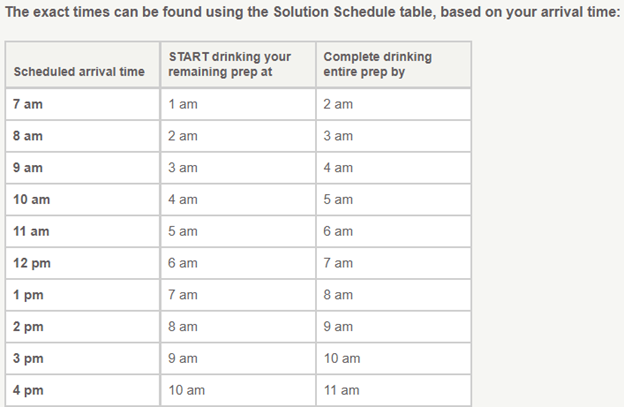
Later in the afternoon before procedure day, take the laxative pills and Half the MiraLAX mixture. Drink the rest of the mixture the morning of. See the instructions for precise times. You are going to be instructed to drink more liquids above and beyond the MiraLAX mix. The goal of all this prep work is to poop out semi-clear, lightly colored liquids. Tell the patient not to flush the toilet because you are going to check it. Gross yes, but it’s better than having to do the whole thing over. Don’t let the patient wander away from a toilet or you’ll be doing some extra poop cleanup. On the day of the colonoscopy do not eat or drink anything in the morning. Take medications with small sips of water. The goal is to not have anything in your stomach that you will throw up due to sedation-caused nausea.


Prep Times example


Source Colonoscopy - Prep and Procedure Overview | Penn Medicine


I got some time left in this lesson, so I am going to include two YouTube videos for the visual learners in the crowd. Fair warning, there might be some test questions.

Video 1.


Video 2.

In the video, the doctor talks about tips concerning a bowel preparation called Golytely. (What a pleasant name for an awful result). It’s basically the same as the MiraLAX mixture mentioned above.


Conclusion

Like this subject, I find myself all pooped out, (which is the goal, right). I can’t think of anything else useful to write about- except to say, remember the record-keeping requirements of the job and- as always,

Good Luck in your Caregiving Efforts.

Mark Parkinson BsPharm

References:

  1. Clyde M. Stauffer; Christopher Pfeifer. Colonoscopy. StatPearls, National Library of Medicine. July 24, 2023. https://www.ncbi.nlm.nih.gov/books/NBK559274/
  2. Colonoscopy. MayoClinic.org, Feb. 28, 2024. https://www.mayoclinic.org/tests-procedures/colonoscopy/about/pac-20393569
  3. Matt McMillen. Colonoscopy. WebMD.com, May 17, 2024. https://www.webmd.com/colorectal-cancer/colonoscopy-what-you-need-to-know
  4. What happens during and after a colonoscopy? You and Colonoscopy Mechanism in Medicine Inc. Dec 22, 2016. https://www.youtube.com/watch?v=mh90RPA-C10
  5. Why Your Doctor Wants You to Get a Colonoscopy. WebMD.com, May 23, 2023.https://www.webmd.com/colorectal-cancer/why-get-a-colonoscopy
  6. Colonoscopy Prep. ClevlandClinic.org. 03/24/2022. https://my.clevelandclinic.org/health/treatments/22657-colonoscopy-bowel-preparation
  7. Colorectal Polyps, Causes, Signs and Symptoms, Diagnosis and Treatment. Medical Centric. Mar 9, 2020. https://www.youtube.com/watch?v=gAE5NZa6V-c


Exam Portal

click on [Take Exam]

Purchase membership here to unlock Exam Portal.

*Important*

Registration and login is required to place your name on your CE Certificates and access your certificate history.

Username MUST be how you want your name on your CE Certificate.


Warning, Area of Burnout Ahead

Author: Mark Parkinson BsPharm:  President  AFC-CE

Credit Hours 3 - Approximate time required: 180 min.

Educational Goal

Tell In-Home caregivers how to avoid Caregiver Burnout.

Educational Objectives

  • Define Caregiver Burnout.
  • Tell how to make a personalized plan of action to prevent caregiver burnout.
  • Introduce the concept of Coping Chemicals and how to manage them.
  • Define stress and tell how to manage it.
  • Explain how Expectations lead to caregiver burnout.
  • List other factors that affect caregiver burnout.
  • List things that can give you caregiving endurance and strength.

Procedure:

Read the course materials.  2. Click on exam portal [Take Exam].  3. If you have not done so yet fill in Register form (username must be the name you want on your CE certificate).  4. Log in  5. Take exam.  6. Click on [Show Results] when done and follow the instructions that appear.  7. A score of 70% or better is considered passing and a Certificate of Completion will be generated for your records.

Disclaimer

   The information presented in this activity is not meant contraindications may be of concern. All applicable manufacturers’ product information should be reviewed before use. The author and publisher of this continuing education program have made all reasonable efforts to ensure that all information contained herein is accurate in accordance with the latest available scientific knowledge at the time of acceptance for publication. Nutritional products discussed are not intended for the diagnosis, treatment, cure, or prevention of any disease.to serve as a guideline for patient management. All procedures, medications, or other courses of diagnosis or treatment discussed or suggested in this article should not be used by care providers without evaluation of their patients’ Doctor. Some conditions and possible


Warning, Area of Burnout Ahead 

When talking with others about Adult Foster Care and in-home caregiving, I have described it as the most difficult, Easy job that there ever was. It is not physically demanding, you never have a huge patient load (max 5 per house), it is not intellectually challenging (the doctor is supposed to do all the brain work), and talk about the perfect workplace- it’s your own home for goodness’ sake. So why do Adult Foster Care homes close after about 5 years? Why do employees of care homes last even less time in the business? If it is so easy, why do you feel so exhausted all the time? Physically, mentally and emotionally exhausted.  

 

Caregiver Burnout


Almost all In-Home caregivers have to face a thing called Caregiver Burnout. According to the website WebMD.com, caregiver burnout is defined as-

“Caregiver burnout is a state of physical, emotional, and mental exhaustion. It may go along with a change in attitude -- from positive and caring to negative and unconcerned. Burnout can happen when you don’t get the help you need, or if you try to do more than you’re able -- either physically or financially. Caregivers who are "burned out" may have fatigue, stress, anxiety, and depression. Many caregivers also feel guilty if they spend time on themselves rather than on their ill or elderly loved ones.”

Did you find that definition beneficial? Neither did I. It is too broad in scope making it almost totally useless for Adult Foster Care providers. You can tell that the writers over at WebMD have never spent 3 days, let alone three years of their life being constantly “on duty” never being able to get away to a place totally separate from their caregiving responsibilities. In other words, I doubt if the writers have experienced Caregiver burnout like adult foster care providers do. To appreciate the topic better we are going to need a more adult foster care-focused definition.

 

Death by a Thousand Paper Cuts

My definition of caregiver burnout is the death of the soul by a thousand paper cuts. Every adult foster care provider starts off with hope and enthusiasm. Look at me. I have found a way to make a living by doing something good. Keeping those who can’t take care of themselves from getting institutionalized. I also get to work in a very homey and comfortable environment. No more big businesses telling me what to do and a boss who doesn’t care about me. I can’t believe I am going to get paid for just doing activities of daily living in my home. This is my dream job.

Then reality sets in. The state comes in and says do this and don’t do that. The families of the residents look down their noses at your efforts. You realize that you have a total lack of privacy. Doctors and nurses assume you’re an idiot or don’t see you at all.  You suffer through night after night of interrupted sleep, pooped pants, peeing in beds, and wandering residents.  Mind-numbing boredom set in as you are required to do the same chores day after day week after week after week. You are tied to the house and get socially isolated. If you are unlucky you have to face the worry of having months on end of not getting enough income because a resident moved out or died. Then comes the dreaded day of the state relicensing inspection. A total stranger comes into your home and judges everything that you have done over the past year.

Individually each problem and task are small and easily handled. But stack them all on top of each and you’ve got a lot of stress that can build up. You seem to be responsible for doing everything. A slave to everyone's whims and demands. Taking care of yourself always seems to be less important than taking care of everyone else’s needs. Being responsive and submissive to the client’s needs feels like you have become their doormat instead.

Month after month you look on and watch your strength and enthusiasm slowly leak away.  There is no escape from the pressure. You can’t go home and leave your work troubles at work. Your home is the workplace. You worry about everything all the time, even when you are away from the residents. Vacations to rejuvenate your spirits are what other people do. There seemingly is no escape from stress.  Year after year you devolve from enthusiasm, to struggle, to trying to just endure and finally burn out and barely care anymore. Extended In-Home caregiving can really suck the life out of you. 
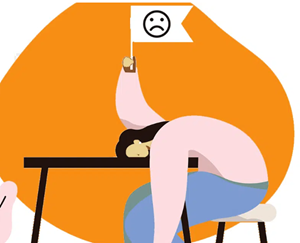
 

It’s inevitable, In-Home caregivers will get burned out--- unless you do something about it.  I have lived the adult foster care life and walked the In-home caregiver walk. After over 15 years in the caregiving trenches, my wife and I have looked the stress monster in the face and got scorched several times. But over the years we’ve also learned a few things about surviving the burnout. Hopefully, I can help you face the stress monster and have enough fortitude to spit into its eye. 


The Plan of Action

Sorry I went all doom and gloom on you. I felt I had to emphasize the point that In-Home caregiving requires a lot of fortitude. Of course, you know that already. Only those who have been in the caregiving trenches like you can appreciate just how much energy it takes. And by energy, I include emotional fortitude and financial wherewithal.  What you may not appreciate is, that no matter how much “energy” you start with, if you do not have a specific plan of action to conserve it or replace it, you are going to run out of the energy that keeps you going.  

So, what are you going to do about it? In my mind, it simply comes down to putting extra effort into two things. 1. Purposely and consistently do good things that give you resilience and strength. 2. Recognize the things that drain you and purposely manage them to minimize the drain of energy. You cannot count on these two efforts to automatically happen by themselves. You must have a plan of action. It’s like putting your foot on the gas pedal. If you take it off, your fortitude engine runs out of fuel, and you coast to a stop. 

Ok, you’ve got to develop a plan of action. What goes into this plan? This is where it gets tricky for me to write about. Each home is a unique situation with its own set of requirements, struggles, and strengths. It is neigh to impossible for me to develop a “one size fits all” program for you to follow. So, I am going to give you the tools to write your own plan of action to keep the caregiving burnout monster away.


The “To Do” list

Do this exercise for me. On a piece of paper write down what thing brings you joy. What gives you peace of mind? What makes you happy? Take your time and really think about it. Keep reviewing and adding to the catalog of positive things for at least a week, or even a month. I will give you some suggestions as we go through this lesson. At the same time, I want you to write on a separate piece of paper all the things that annoy you. What do you hate to do? What are the things that throw you out of balance?   I am going to talk about a few things that you may not have considered. Take just as much time on this one as well. As you write your catalog of negative things ask yourself, “What can I do to manage or eliminate the stressors”?  I am going to give you some suggestions about that too.

Now take both catalogs and turn them into “To Do” lists. Think of each item on both catalogs as a list of goals. The “To Do” list will be items that help you work towards accomplishing those goals.


Tah Dah- you have just made a Plan of Action to fight burnout that is totally customized for your own unique caregiving situation. Work on the list daily and take satisfaction in crossing off each item. That alone will give you a sense of accomplishment that will rejuvenate your soul. When the list gets small, refer back to your positive and negative goals and then make a new To-do list. Some things you will write over and over again. That’s okay if you repeat yourself. You are still purposely and continually putting effort into keeping the monster at bay.

Is the catalog of goals going to change over time? It had better change. Life changes and you are going to get better at the In-Home caregiver thing. Some items will become more important, some things will become less stressful because you are now more skilled. If your goals don’t change then you are not being specific enough, or you are not getting more skilled, or you are just not putting enough effort into it. Speaking of that, is this all worth the effort? You bet. You are going to retain your dream job or keep your business going. You are working on the very things that are going to keep you energized, sane, and in business for the long haul.


Building a more Focused and Detailed Plan  

Regardless if you follow the To-do list strategy or not, you must understand the underlying principles that cause burnout in caregivers. Once you have a good understanding of the causes you can construct a more detailed oriented, principle-driven plan. A plan that is more flexible yet durable. A program that will be able to grow and mature as your career in In-Home caregiving grows and matures.

Coping Chemicals
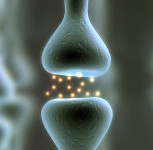
Everyone is born with a biological system that enables the body to protectively respond to the stressors of life. That system in turn is controlled by the nervous system. Which is, in its turn, controlled by a multitude of neurotransmitter chemicals and hormones. I simply call the whole thing the body’s Coping Chemicals. We use up some of our internal stores of coping chemicals as we deal with the stresses of life. The body then replaces what was used up and we are able to continue facing the pressures that we experience.  But, what happens when the stresses of life use up more coping chemicals than can normally be replaced?  The system starts to malfunction. Little by little we start to lose our ability to respond appropriately. We start to lose some of our resilience. Recovery from hits to our psyche takes longer and longer to achieve. We start to get mad more often. We feel more exhausted, and we lose the ability to care about anything.  We can’t help ourselves. We simply don’t have enough coping chemicals left to elicit the correct protective responses.

Signs that we are running out of Coping Chemicals.

  • Having less energy than you once had.
  • Lowered immunity. (Catching every cold or bout of flu that’s going around.)
  • Feeling constantly exhausted, even after sleeping or taking a break.
  • Don’t care about taking care of your own needs.
  • Gets little satisfaction in your caregiving.
  • You have trouble relaxing, even when help is available.
  • Become easily irritated, frustrated, or angry with others.
  • Feeling helpless and hopeless.
  • Unable to concentrate or have trouble making choices
  • Withdraw from friends and family
  • Have lowered self-esteem
  • Feeling like you’re in over your head and everything is going wrong.

If you continue down this path you will literally make yourself sick, emotionally and physically sick. You’ll turn into a very grouchy or uncaring individual. The quality of your caregiving will drop. The danger of neglecting or abusing the very people you are trying to take care of will increase over time. Eventually, you will quit or be forced to quit the profession. If you start to experience the signs, then you know you are running out of coping chemicals. You will need to do something about replacing what has been lost.
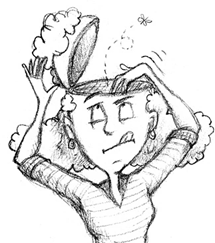
How to get more Coping Chemicals  

  • Healthy diets- This principle is easily understood. You must have enough of the right materials in your diet if you are constructing more coping chemicals. That means consuming a nutrient-rich diet. In adult foster care homes this will happen automatically if you cook from scratch. Remember to include plenty of fruits and vegetables in your menu plan. I’ll talk more about food later on.
  • Good Bacteria- Research shows a connection between the good bacteria in your gut and mental health. Eating probiotic foods like sauerkraut, yogurt, pickles, buttermilk, and kefir may help your mental resilience.
  • Supplements- Taking a multivitamin helps ensure you your getting enough nutrition. Normally as a pharmacist, I do not recommend stress formula vitamins. I think a proper diet and a multivitamin is enough. But if you are in great need, then a stress formula may be justified. The same principles apply to probiotic (good bacteria) supplements.
  • Relaxation and proper sleep are restorative. They give the body time to replenish its coping chemical stores. That means purposely scheduling naps and “me time” in your daily schedule. If you are forced to lose sleep at night, then increase the naps to compensate. You are looking for at least 7 hours of sleep per day. If you do not have someone to watch while you nap, purchase a baby monitor system.
  • Exercise- Physical activity increases the release of endorphins, the body's “feel good” coping chemical. It also distracts the mind and helps it to relax. It is well understood that a strong body is more resilient and immune to stress. I liked taking walks with the residents to get my exercise. Gardening is also good and lowers the food bill at the same time. I also think that purchasing a treadmill or exercise bike is justified in Adult Foster Care homes. Purposely include such activities in your action plan.
  • Surprisingly, getting enough sunshine is also helpful in restoring coping chemicals. If you can’t get outside, light therapy lamps are designed to mimic the sun for its benefits.


     Stress

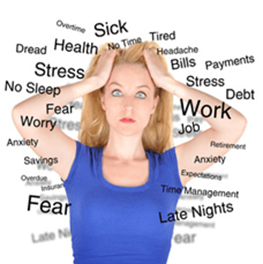
Stress causes burnout- sort of.


Another underlying principle I think you need to understand is, what is stress? There are many different definitions of the word stress. I like the Mental Health Foundation’s definition. “Stress is our body's response to pressure…. It is often triggered when we experience something….” In regards to this course, stress is a coping chemical response. It is our control system trying to motivate us to do something. Once we start to do something, the need for motivation is lessened and we feel less stress. Of course, if the situation does not improve then the stress response continues, taxing our other coping chemical reserves. So, excessive and/or chronic stress causes caregiver burnout. But it is not the root of the problem. To control burnout, you must work on the events that create the need for the stress response.  It’s the old “a stitch in time saves nine”.  As you think about your burnout prevention plan of action, run your life, your business, and your career in a way that you don’t need to be motivated to do something.

I hope that most of you are getting the implications of what I am saying. It means changing the way you look at things. As you make your list of things you hate or the things that stress you out ask yourself, Why? What are the underlying reasons? Take time to peel back the onion layers and be honest with yourself. You must find the root of the problem.  

Let me give you a few examples.


State inspections cause stress. Or more accurately being unprepared for state inspections causes stress. If you are 1. unknowledgeable about state regulations concerning AFC homes or 2. You are unwilling to sacrifice certain things in your personal life or 3. Are just too lazy to comply with the regs, then you will experience a lot of stress at inspection time. If you don’t do something about being prepared, that stress will eventually wear you down. So being prepared for the inspection becomes the goal.

Now the “to do” list item. Learn from the state inspector.

If it was me, I would not view the state inspector as a punisher, a giver of stress. I would view them as an expert on state regulations. Utilize them as a teacher, instructing you how to comply with the regs. That changes them from a drag on your coping chemicals to a resource that can eliminate the need for the motivation to act. They can, if properly used, actually reduce your stress. Also, easily passing an inspection is a great source of pride and satisfaction. Both feel pretty good if I do say so myself. Feeling good increases your coping chemical reserves.


Chaos causes stress. Or more accurately being unorganized creates multiple events that cause the need to act. That stimulates multiple stress responses. So, the goal is to experience less chaos.

The “to-do” list. Get organized

If it were me, I would put a lot of effort into regulating the daily activities of the home. Create a schedule of chores to accomplish. Daily, weekly, and monthly. The idea is to know in advance what needs to be done, who needs to do it, and when it needs to be done. Calendar events. Write important stuff on a calendar so you can be prepared in advance.  Write a menu so you will know what needs to be prepared and what items you need to purchase. Can you see how that eliminates the need to be motivated to act? Being organized reduces stress and fights caregiver burnout. Less stress from less mess. Sounds like a good saying to put on a poster and hang it on a wall someplace.


Emergencies cause stress. Accidents and emergencies happen to everyone. Care homes are particularly vulnerable to traumas because of the reduced health conditions of their clients. The stress of the situation motivates you to act.

The “to-do” list.  Emergency response procedures.

After an emergency, review the situation and think about how you could have had a better outcome. Then establish care procedures that tell what to do step by step.   Well-thought-out procedures reduce the need for the “motivation to act” response. In other words, “Having the Trauma without the Drama”.  
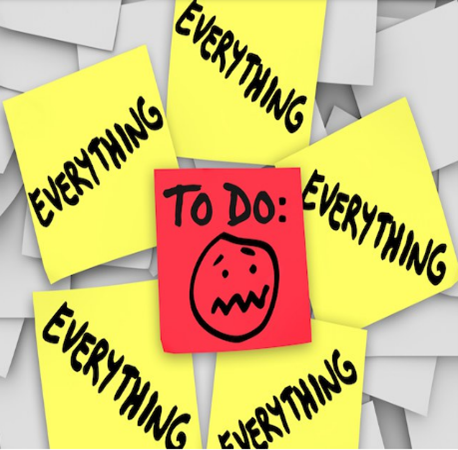
 

Accumulation of roles causes stress. In-Home caregivers tend to think they have to do EVERYTHING. While it is true that you are responsible for everything you are not required to DO everything. Can you see how making yourself act on everything multiples the stress response?


The “to-do” list. Delegate

Make a list of duties and make assignments. Clients, your family, and employees can do a lot of the menial things around the home. Clients get bored and need something to do. It also helps with their self-esteem if they have responsibilities. One thing I wish I had done when I had my AFC homes is hiring a cleaning service. Care home owners, do you want to make your care employees last longer in your employ, get a cleaning service.


Lack of Sleep Causes Stress

Wanting to sleep when you need to be awake is an automatic trigger for the stress response. You need to be motivated to get things done, stress is the body’s natural response.

The “to do” list -Keep track of sack time.

Having more time to relax and proper sleep is essential in preventing caregiver burnout. I think it is thee most important element of your plan of action.


Lack of knowledge causes stress. If you do not know how to do something, then the stress response continues unabated. You can reduce the stress by getting in the know. You don’t have to know everything but if something comes up on a regular basis or a client has an unfamiliar diagnosis it would be wise to get in the know.

The “to do” list- Educate yourself.

Seeking knowledge reduces stress in the future. Make a list of things you want to know and take advantage of the internet. Talk to experts. Read all my CE courses (a shameful plug for my service).  Time educating yourself will pay dividends down the road and prevent burnout.


Not having enough resources is stressful. If you do not have the equipment or supplies handy, the task cannot be completed. A stress that cannot be resolved turns simple tasks into chronic stress issues.

The “to-do” list. Create an Inventory system.

List all the items that you normally use. Decide how much is needed, then keep that amount in the pantry. Utilize the -Use one, Buy one- purchase system to keep the supply levels up. You can take advantage of sales and buy more when the opportunity arises. In the long run that will lower the operating costs of the business and keep you well-stocked. You can add food supplies to your stored inventories. Deciding what is for supper is a lot less stressful if you have a well-stocked pantry.


Lack of Funds causes stress. You will notice that I did not write finances causes stress. Just the opposite is true. Money on hand reduces stress. It enables crossing off most items on your ‘to-do’ list. Money on hand solves problems. Readily available cash prevents emergencies from even occurring.
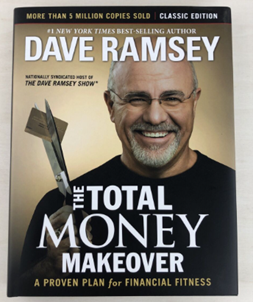
The “to-do” list. Read Dave Ramsey’s Book- Total Money Makeover.

You have got to manage the money. If you do not know how to use a budget, you will get burned out. In-Home caregiving without money management is just too stressful. In his book, Mr. Ramsey says, to start with an emergency fund of $1000. Then work on eliminating short-term debt. In addition, build up your emergency fund to equal 3-6 months’ worth of money. You have to have money to cover your needs and bills if everything falls apart. Like having your clients die or move out. Then work on paying off the house. If it was me, I would add to the budget a place for personal mad money. Money that can be blown on anything you want without any other considerations. If you want something silly or stupid, then save up your mad money and get it without any stressful remorse.

I cannot cover all items that cause stress. I hope you got some good ideas from my Goals and “To-Do” list items that I wrote about. Did you see how I turned annoyances into items to work on? Get a good system going and you will greatly reduce the stress in your caregiving world. You will be more resilient if you put some effort into it.


Expectations

The third underlying principle that leads to caregiver burnout is how expectations affect our attitudes. Expectation is defined as the strong belief that something will happen in a certain way.  It is a major part of why a person acts the way they do.  When we expect things to have good outcomes, we tend to notice the positive aspects of our lives and ignore the negative. The opposite also occurs. Negative expectations lead us to notice only the bad.

Caregivers who have positive expectations are hopeful that things will turn out fine. Positive expectations encourage the caregiver to work past obstacles and chase dreams of success. They lead the caregiver to see things in a positive light. This encourages us to achieve happiness and fulfillment in our caregiving efforts.  When someone says how are you say, “I’m a happy guy”.

Unfortunately, there is a danger in always expecting the positive to happen. Just expecting positive things to happen will not always make them happen in reality. When reality falls short of our expectations, disappointments are felt. The harder we cling to our positive expectations in the face of reality the greater the letdown. Continued letdown leads to disillusionment. Continued disillusionment leads to frustration which in turn leads to dissatisfaction. Continued dissatisfaction leads to negative expectations which in turn leads to caregiver burnout.

Gratitude

So how does a caregiver avoid this expectation vs reality burnout trap and still enjoy the good outcomes of a positive outlook? In a word Gratitude.

In an article from verywellmind.com Elizabeth Scott PhD said,

“When your expectations outpace reality, it often means you don't appreciate what you do have. Instead, you may find yourself expecting more or comparing what you do have to what you could have.

For example, one study found that participants who were exposed to a subliminal reminder of wealth spent less time savoring a chocolate bar and exhibited less enjoyment of the experience than other subjects who weren't reminded of wealth.

Gratitude is all about appreciating what you have instead of lamenting what you don't. Research has found that practicing gratitude and working actively to savor the moment can have a positive effect on subjective well-being and happiness.”

Being grateful for the blessings we obtain helps balance our expected outcomes with what reality actually gives us. It can embolden you to persevere in the face of adversity. It can enable you to be more resilient and have more stamina. I suggest that you look at gratitude as a caregiving tool. A technique that needs to be practiced and applied with skill. For example:

  • Elizabeth Scott also suggested that “Spend a few moments each day thinking about something you are grateful for. Or consider writing in a gratitude journal.”
  • Genuinely thank those around you for the things they do for you.
  • If you pray, tell Heavenly Father how grateful you are for what He has sent you.
  • Routinely step back and assess what is happening in your care home. List the good things but don’t ignore the bad.
  • Frame the bad as “opportunities to learn” and be grateful that you have gained valuable insight into what not to do in the future.


Expectations of Those Around You

Now let’s look at how the expectations of your clients, your family and the support staff affect you the primary caregiver.  No one exists in a bubble. We need the cooperation of those around us to have our expectations realized. Those who cling to their expectations the most, endeavor to control others to make their expectations into reality. That puts a lot of pressure on the main caregiver. When expectations are not met, frustration and anger follow, adding to caregiver stress. That is referred to by some experts as the “reality vs expectation trap”.

If you are at the receiving end of this frustration and anger, I would suggest that you put in efforts to manage the expectations of those who are dishing it out. Here are a few suggestions:

  • Teach everyone about their role in the care home. Ensure that everyone knows who is responsible for doing what. Expectations will adjust by themselves if realities are clearly defined.
  • Communicate effectively. Take time to really listen and ask probing questions. Repeat back what you hear to make sure of your understanding. Clearly express your expectations. Make sure they understand your goals.
  • Establish reciprocity- I am going to do this for you, and I expect that you will do that for me. Together we will get what we both want. Thus, you have converted a detractor into a supporter.
  • Educate everyone about the need for personal responsibility in fulfilling expectations.
  • Help others avoid the “reality vs expectation trap”.
  • Point out the positive that is happening in the lives of others.

  • Reinforce gratitude in others by genuinely accepting compliments and returning thanks.


The Expectation of Caring for Close Family Members

One of the hardest things I know in In-Home caregiving is taking care of a close family member. Expectations force the caregiver to be the controlling caregiver and the submissive child or supportive relative. Often those roles are in opposition to each other and thus almost impossible to do at the same time. My suggestion is to view this problem as an expectation vs reality issue. Many of the above techniques will help in this situation. If you must choose which role to take, I think it is more effective to be the dominant caregiver first. Then add in moments of supportive relative to provide balance. What does that look like? Demanding compliance with your wishes then afterward giving them a hug and thanking them for their sacrifice to make things work. Then express your sincere belief that the outcome will be positive.

People who have mastered the art of setting realistic expectations for themselves and others experience a healthier attitude and a more positive outlook on life. They become less demanding of others. As a result, they experience fewer disappointments and fewer frustrations. Caregiver stress is lessened, and the risk of burnout is reduced. 


Other Factors That Affect Caregiver Burnout

There are so many other things that could affect your attitude or could cause you stress. I could not think of a way to combine them all under one underlying principle other than to call it the miscellaneous category.

Personal Health Issues

The longer I live on this planet the more I come to realize that there is no perfectly sane person out there. We all have to contend with the Crazy bits in our psychological makeup. Under normal conditions, we have learned how to compensate and get by despite our weaknesses. But under the constant pressure of 24/7 caregiving those mental health issues may start to poke out more. Don’t beat yourself up about it. Under these conditions, it is perfectly normal to be abnormal. Wallowing in self-pity about your supposed weaknesses is a trap that leads to burnout. Just go get some help from a medical professional and soldier on. I guess the same could be said about any health problem you have. High blood pressure, being overweight, diabetes, or whatever.  Taking care of yourself first enables you to take better care of others. 

Depression and Antidepressants

Let’s focus on depression for a moment. For the purposes of this lesson, there are two types of depression. Using up all your coping chemicals and clinical depression. They both have similar signs and symptoms and only a mental health professional could tell them apart. It doesn’t matter though the treatment is the same- antidepressant medication. Being a pharmacist I am such a medication freak. I just got to point out that many antidepressants work by blocking the reuptake of neurotransmitters in the brain. In plain English, it is making better use of the limited amount of coping chemicals to get the job done. Coping chemicals, depression, burnout- science is so cool, right?  I do have to point out that messing around with your coping chemicals might make you less responsive emotionally. My wife took antidepressants and said it felt like being flat emotionally. It may seem like you are starting just not to care. If you notice this in yourself, it’s probably just the meds talking. But pay attention if it gets worse over time. Remember not caring is a warning sign for caregiver burnout. Talk things over with your doctor. 

Compassion Fatigue

Compassion Fatigue is different than Caregiver Burnout. It is getting overwhelmed emotionally, physically, and spiritually after taking care of too many serious nursing cases. You’re not getting burned out, you’re just getting tired. You can tell the difference between the two by how fast the symptoms come on. Usually taking a break to recharge the caring batteries is all that is needed.

Social Isolation

24/7 caregiving really limits the amount of social interaction that you get. Lack of interaction with others can make you feel very lonely, insecure, and depressed. It also gives the caregiver a case of tunnel vision or living inside a bubble. You need to interact with others. It counteracts the loneliness, refreshes your batteries, validates your worth and you benefit by experiencing different points of view. If you can’t get out to mingle with people, then you have to get your people to come to you. Start inviting more people to come over. Have more parties or call your friends just to gab. Take advantage of internet groups. Use things like Facebook as a tool to fight caregiver burnout.

 

For heaven's sake go to church. There is no better environment for a caregiver than an entire organization built on the principles of support and improvement.

 Work Environment

The environment that you work in has a huge effect on the stress that you feel. Step back and take a real good at how your home is set up. Does it add to or take away from the pressure? Go through your home and redecorate and reorganize your procedures to maximize comfort and tranquility. Don’t forget calming scents and tranquil sounds in your efforts. Don’t be afraid to change things up just for the joy of it (holiday decorations come to mind)

Feeling Powerless

Studies show the number one issue that causes caregiver burnout is feeling powerless. You might feel trapped by financial considerations or feel stuck in a caregiver situation that you didn’t expect. These naturally lead to feelings of resentment and hopelessness. Don’t fall for that trap. That is a road that spirals down to caregiver burnout. Your situation may be limiting but you are never without the power to improve things, especially mentally.

  • Practice acceptance- You may be in a situation that you didn’t choose, and you don’t like- but don’t get your nickers in a bundle worrying about it. Instead of spending your energy complaining, just accept things as they are. Use your precious energy to do things that bring you joy instead.
  • You are not powerless to act- Action always wins out over doing nothing. Even if you make mistakes. Move on and try to improve the situation.
  • Get creative, and think outside the box of your expectations.
  • When there is nothing to do, don’t sit and veg too much. That leads to being a caregiver zombie. Take advantage of the lull in the action to do things that make you happy.
  • Make a “Things that Make Me Happy” list. Gather the supplies you need ahead of time so you can do them when the opportunity arises.


The Good Stuff

Let’s finish up by talking about some things that can give you more strength and power to carry on.

  • Remember you are doing good. You made a conscious choice to sacrifice so that others may feel better. That makes you a caregiving HERO. That’s a lot more meaningful and satisfying than flipping burgers for a living.
  • Think of what would happen if you weren’t there. More caregiver HERO stuff.
  • If you are taking care of family members (especially parents) focus on the positive thought that you are repaying them for what they did for you.
  • Talking about things helps. Find someone you can trust that you can complain to. Do not suffer in silence.
  • Blow off some steam by doing active things. Get an active hobby. Watch a sport or a movie that gets you excited.
  • GO TO CHURCH. Even if you must pay someone to babysit.
  • Set aside a private place. Stock it with personal pampering things. This is not a luxury. This is a necessity.
  • Establish some boundaries where caregiving cannot cross.
  • Scented candles, incense, or a pot of steaming cinnamon water are wonderfully refreshing. So is calming mood music.
  • Budget money to hire help. You don’t have to do everything. In fact, you shouldn’t do everything.
  • Learn to say NO. More of that you don’t have to do everything again.
  • Budget time and money for away time. Vacations are just not for other people. Even little mini vacations like going out to eat or taking in a show are worth their weight in gold.
  • Daily exercise or yoga reduces stress.
  • Puzzles fight boredom and are an easy way to escape pressures.
  • Read a book. Reading a book creates a mental space where caregiving cannot enter.
  • Have some pride in what you do. You are a caregiving powerhouse. No one else spends more time with patients than you. No one is more knowledgeable than you are about how your residents act and feel. No one is a better advocate for the patient than you. Who else can chew out a doctor and get away with it?
  • Be realistic, you can’t cure everyone. Sometimes you can’t even keep someone stable.
  • Talk to a professional, such as a therapist, social worker, or clergy member.
  • Find caregiver support groups or workshops that can help you find ways to manage stress.
  • Regularly take personal assessments. Think deeply about the Whys of the events around you.
  • Go to the computer and type in [the diagnosis of your resident] and caregiver support.


Here are some other resources that you might find useful


Conclusion

You are a wonderful person. Thank you for sacrificing to take care of those in need. Be careful not to expend all your energy doing so. You are too valuable a resource to the rest of society to be wasted by overtasking yourself.  Be mindful of your coping chemical supplies. You can tell when you’re running low by how drained you are and how easily you become grouchy. Develop a plan of action. Purposely and continually work on the plan you have developed. The rest of us want you to be where you are doing good for the long haul.

As always Good Luck in your Caregiving efforts.

Mark Parkinson BsPharm

PS

Did you notice that this entire lesson could be titled How to Run Your Business Better and Out-Compete Your Competitors? This is the “Secret Sauce” of good caregiving guys and gals. You won’t get this stuff from other CE sources. (another shameless plug for my service) If you already know all this stuff, good for you. I apologize for boring you. At least you got 3 hours of CE out of the way.


References:

  1. The Stress-Diet Connection. Health & Nutrition Letter, Tufts University, July 22, 2021. https://www.nutritionletter.tufts.edu/healthy-eating/the-stress-diet-connection/
  2. Mental Health Effects of Unrealistic Expectations. WebMD.com Feb 25, 2024. https://www.webmd.com/mental-health/unrealistic-expectations
  3. Moshe Ratson. How to Manage Expectations. Psychology Today, Sept 20, 2023 https://www.psychologytoday.com/intl/blog/the-wisdom-of-anger/202309/how-to-manage-expectations?msockid=0d79d8cfe18b638f2bbacdd4e084623a
  4. Caregiver Burnout. ClevelandClinic.org, 08/16/2023. https://my.clevelandclinic.org/health/diseases/9225-caregiver-burnout
  5. Avoiding Nurse Burnout Nursing CE Course. NursingCE.com, 06/13/22 https://www.nursingce.com/ceu-courses/avoiding-nurse-burnout-nursing-ce-course
  6. Elizabeth Scott. The Expectations vs. Reality Trap. VeryWellMind.com, Apr 18, 2022 https://www.verywellmind.com/expectation-vs-reality-trap-4570968


Exam Portal

click on [Take Exam]

Purchase membership here to unlock Exam Portal.

*Important*

Registration and login is required to place your name on your CE Certificates and access your certificate history.

Username MUST be how you want your name on your CE Certificate.

TENS Units- An Electrifying Topic of Caregiving

Author: Mark Parkinson BsPharm:  President  AFC-CE

Credit Hours 1 - Approximate time required: 60 min.

Educational Goal

Tell Adult Foster Care Providers what TENS unit is and how to use it.

Educational Objectives

  • Tell what Transcutaneous Electrical Nerve Stimulation therapy is.
  • Instruct how to use a TENS unit.
  • Discuss using the TENS unit in AFC home settings.

Procedure:

Read the course materials.  2. Click on exam portal [Take Exam].  3. If you have not done so yet fill in Register form (username must be the name you want on your CE certificate).  4. Log in  5. Take exam.  6. Click on [Show Results] when done and follow the instructions that appear.  7. A score of 70% or better is considered passing and a Certificate of Completion will be generated for your records.

Disclaimer

  The information presented in this activity is not meant to serve as a guideline for patient management. All procedures, medications, or other courses of diagnosis or treatment discussed or suggested in this article should not be used by care providers without evaluation of their patients’ Doctor. Some conditions and possible contraindications may be of concern. All applicable manufacturers’ product information should be reviewed before use. The author and publisher of this continuing education program have made all reasonable efforts to ensure that all information contained herein is accurate in accordance with the latest available scientific knowledge at the time of acceptance for publication. Nutritional products discussed are not intended for the diagnosis, treatment, cure, or prevention of any disease.


TENS Units- An Electrifying Topic of Caregiving

Recently my wife had to use a TENS unit as part of her physical therapy for an injured shoulder. It brought back memories of when I first had to deal with a TENS unit as a caregiver many years ago. I thought, what’s a TENS unit? How do I operate the dumb thing? How much does it cost? Is it dangerous to operate? Is it worth the effort? Let me tell you about what I found out.


What is a TENS unit?

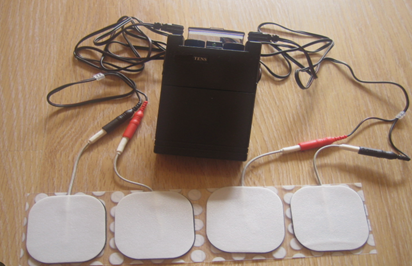
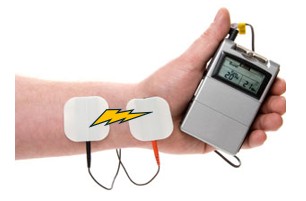
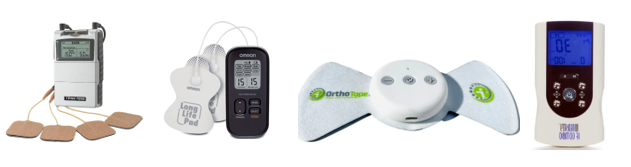
A TENS Unit is a small mobile electrical device about the size of a cell phone used for pain relief.  It has wires that connect to electrodes embedded in pads that are attached to the skin. The device sends a small electrical current via the electrode wires into and through the area of pain. It is powered by a 9-volt battery system.  The batteries are either replaceable or rechargeable.

How does it work?

TENS stands for Transcutaneous Electrical Nerve Stimulation. (Transcutaneous means applied across a depth of skin).

As the name implies, the device is designed to send a small electrical current from one pad to another through the skin. The exact method of pain relief is currently not known. It is believed to be one or a combination of the following.

  1. Blocks pain nerve signals from reaching the brain. The brain has only a limited supply of nerves that signal pain. The electrical impulse sensation occupies many of the nerves that otherwise would be sending pain sensations.
  2. Sends a counterirritant signal to the brain. The brain is distracted away from the pain sensations. Something similar to rubbing a banged elbow.
  3. The electrical impulse stimulates the release of endorphins. They are hormones that your body produces to relieve pain, reduce stress, and improve your mood.

Side Effects?

Used as directed, TENS therapy is tolerated quite well. The only significant side effect that has been reported is minor skin irritations at the site of the pads. There are cases though where the TENS therapy would potentially cause harm.

Contraindications:

  • The patient already has an implanted electrical device, like a heart pacemaker or insulin pump.
  • Has metal implants.
  • Used during pregnancy.
  • Epilepsy
  • Has a malignancy (Cancer).
  • Deep vein thrombosis
  • Avoid the areas of the face and head, front of the neck, front of the chest, anywhere internally, over tumor or malignancy, directly on the spinal column, or around open wounds

Does it Really Work?

The use of electricity for pain relief dates back to ancient Rome and Egypt. Patients were told to step on electric eels in water.  TENS therapy is an “add-on” therapy because it will not eliminate pain by itself. It just reduces how intensely it is felt.  It does not heal the injury either, so its effect is only temporary.  Unfortunately, there are those who receive no significant reduction in pain at all. One video made by a pair of physical therapists I saw claimed only about 50% of patients received benefits from the use of a TENS unit. In 2009 The American Academy of Neurology published guidelines for TENS unit use that stated that the TENS therapy was not effective in chronic lower back pain but was effective in diabetic neuropathy. My wife said the TENS unit helped her with her post-surgery shoulder pain.

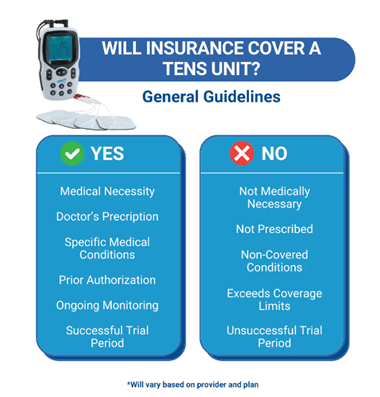
Does Insurance Cover the Cost?

As of the writing of this article, TENS units cost between $20 to $70, with some fancier models going for as much as $125.00. They are available for purchase online or at a medical equipment store without the need for a prescription. You also can rent a device from a medical supply store. Having said that, will insurance pay for a TENS unit? Not automatically. Each insurance policy is different. There are going to be some hoops and loops to jump through. At the bare minimum, a prescription will be required. I recommend that you go through a medical supply store and let them handle the details. If that is not an option, call the help desk number on the insurance card and ask them how you get reimbursed if you pay for the unit yourself.  The website CAREX.com says,


Quote

Generally, the criteria for getting a TENS unit covered by insurance are the same. Here are the basics: TENS therapy must be deemed medically necessary and effective in treating the primary health issue – in this case, pain. For TENS therapy to be deemed medically necessary, patients must undergo a 30-day trial of transcutaneous electrical nerve stimulation treatment, preceded by a reassessment of the symptoms.

The post-trial reassessment of the patient’s pain-related symptoms must indicate:

    • The frequency with which the TENS unit was used during therapy and the average duration of use during each therapy session.
    • The effectiveness of TENS in relieving the patient's pain-related symptoms.

In addition, the following criteria need to be met:

    • The pain has been unresponsive to conservative medical therapy for a minimum of 3 months; AND
    • The trial occurs under the direct supervision of a medical professional.

Continued use of the TENS unit will be deemed medically necessary for the treatment of pain if the following criteria are met:

    • The TENS unit was used throughout the initial TENS therapy trial.

TENS therapy, including the TENS unit, will not be covered if:

    • TENS therapy is not deemed medically necessary.
    • TENS therapy is only deemed necessary for post-operative pain, not for acute pain.
    • TENS therapy is being used to treat non-pain-related conditions, such as dementia and headaches.

End Quote


Which is the Best?

I personally have no preferences for which brand is best though the insurance company or the prescriber may. If a physical therapist is involved ask them for a recommendation.


TENS Units and Adult Foster Care

TENS therapy is generally well accepted as a safe “add-on” treatment in pain management.  It may or may not help, but it won’t hurt the patient either. The overly simplified justification for its use is “It can hurt so let’s give it a try and see if it helps. Thus, TENS therapy becomes a tool for In-Home caregivers to ask the doctor when regular methods are not effective enough in managing the resident’s pain levels.  However, its use presents some challenges for AFC providers.

  1. TENS is therapy. You have to get a prescription from the doctor and write it in the MARS. If you go to a physical therapist (PT) and they suggest its use, then you have to go back to the doctor for the prescription. The PT may do that for you.
  2. Each TENS unit comes with easy-to-follow instructions, but it does take some skill. Does that mean you have to get a nursing delegation to operate a TENS unit? I don’t know. To be safe talk to your county home inspector to be sure. If the answer is Yes- you need a delegation. Ask the person who said you need a delegation if the PT can do the delegation training. If they say no to the PT remind them that PTs are considered the experts over and beyond nurses.
  3. Determining which setting to use on the TENS unit would be considered choosing a therapy. The PT would have to tell you which setting to use as part of the delegation training or the doctor would have to include that in the prescription. (Including it in delegation training is a whole easier to accomplish. But it would require a referral from the doctor to see a PT)
  4. The prescription will often say- UD- use as directed or PRN as needed. For AFC providers, UD means training required and PRN means PRN log entries required in the MARS.
  5. Remember to put all actions taken (referrals, delegation training, etc.…) in the resident’s file.


The Settings and Modes

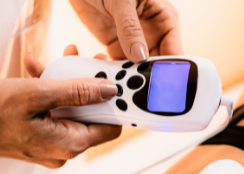
The modes and settings of the TENS unit will be determined by someone else, but it does not hurt to know what they are talking about in advance.

Modes

Most TENS units come with a pre-selected group of settings called a mode.

For example:

Normal- The device sends out a pulse rate that is consistent and never changes.

Burst- The device sends out a burst of pulses with a break in between.

                                                         Modulation- The pulse rate cycles through several preselected settings. 

Which mode is best depends on the type of pain and the goals of therapy. There is always an element of guesswork in determining the mode so be prepared to monitor for effect (PRN log) and report back to the PT or Doctor your observations.

Settings

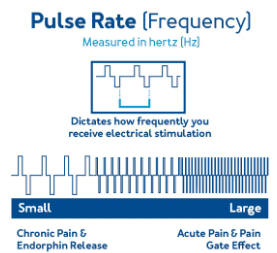
  • Rate/Frequency- The flow of electricity comes in waves (measured in hertz). The pulse rate concerns how fast the waves come. It is also called frequency or how frequent the waves come. The higher the frequency the faster the waves.


Note- Low frequencies stimulate the release of endorphins and fast reacts interrupts pain signals to the brain.

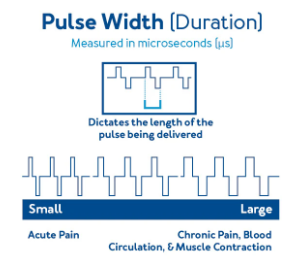
  • Width/Duration- This is the measure of how long a pulse lasts. (in microseconds). The more extended the pulse time the stronger the stimulation is.


Note- Having high frequencies and durations may get too strong and become uncomfortable for the resident.

  • Intensity- This is an indication of how strong the electric signal is (measured in microAmps). How strong the signal needs to be is also determined by guesswork. Normally you start low and then increase the amps until the desired effect is achieved. (titration)

Note- Titration should be part of the delegation training. I might also suggest you watch the body language of the resident for clues of effect. (blank face versus grimacing face). I also would suggest that you try the TENS unit on yourself to give an in-depth perspective on therapy.


Timing

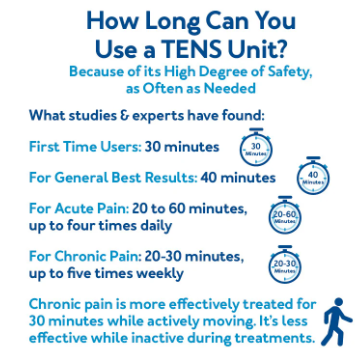
Unless the unit has automatic shut-off features, the duration of therapy sessions will have to be done manually. Because of how safe the therapy is, you can go for as frequently or as long as needed. (Timing is also determined by someone else, even if it is PRN).  Here are some general guidelines as presented by an article in Carex.com


Note- The body can get used to stimulation. You may have to increase the therapy as you go for continued effect. Consult with the powers that be before doing so and include the action in your files.


A few More Caregiver Notes

  • Do not use it while sleeping. You can’t feel pain while sleeping, so why use the device and get the resident desensitized to therapy?
  • Turn the device off before removing or moving electrode placement. Failure to do so can result in the device “zapping” you.
  • Remove the pads by peeling from the side. If you pull by the wires the connection will wear out sooner.
  • The pads usually come sticky out of the package. To make the sticky last longer, remove oils from the skin before placement and or clean the pads with water after use. After removing the pads, place them back onto the plastic they came on originally.
  • Replacement pads can be purchased, or you can Velcro the pads to a belt or sash. That may be caregiver convenient, but then you have to monitor for belt or sash slippage.
  • Leaving the pads on between sessions may save some caregiving efforts but you will have to monitor the skin for redness and irritation.
  • TENS Units can come with a clip that can be placed on a belt or clothing. Ensure the dangling wires are secured so they don’t catch on things. Also, the clip may come loose when going to the bathroom. Having the electronic device fall into the toilet is a bad thing.
  • Hot or cold packs can be used on top of the TENS units. There may be some synergistic effects achieved. Ice may sensitize the skin.
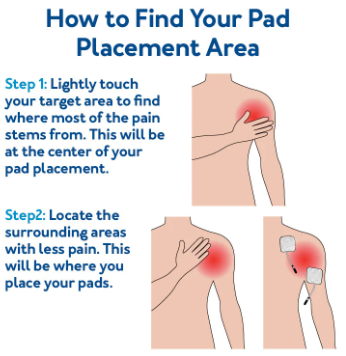
  • It doesn’t matter which wire goes to which pad, even if they are color-coded. The idea is to have the current flow through the painful area, from the sending to the receiving electrode. See pad placement.
  • Decrease or stop therapy if the muscles start to twitch.


Pad Placement

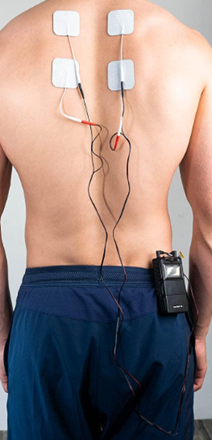
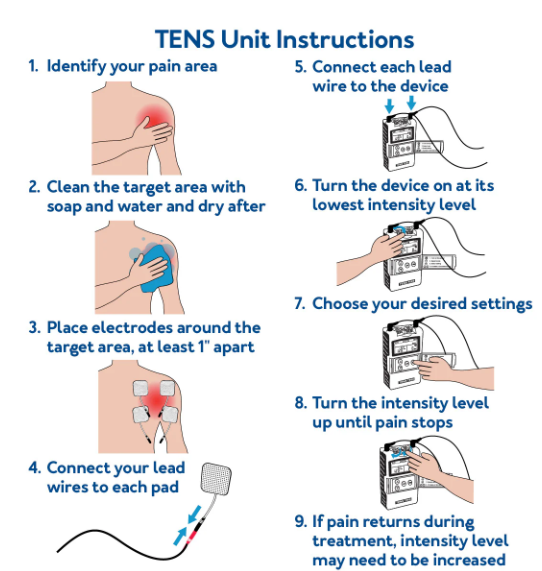
The ideal position for pad placement is going to be a matter of experimentation and adjustment. The PT will give you some directions on where to place the pads. If you forget, here are some general guidelines.


Overview of Instructions

#Source- https://carex.com/blogs/resources/how-to-use-a-tens-unit

For visual learners here are two YouTube videos I found, or you can do an internet search. Type in the search field - (your brand name), how to use, TENS. Watching is recommended but not required. There will be no exam questions on the videos.


Conclusion

Pain management especially chronic pain is one of the more difficult caregiving tasks that In-Home caregivers have to deal with. TENS units are another tool in your caregiver toolbox that you could call on to help your resident. It will take a prescription and training to use but often there is no other choice when pain meds aren’t enough.

As always, Good Luck in your caregiving efforts

Mark Parkinson BsPharm


References:

  1. Guideline: Widely Used Device for Pain Therapy Not Recommended for Chronic Low-Back Pain. American Academy of Neurology. https://www.aan.com/PressRoom/Home/PressRelease/784
  2. Brandon Landgraf. How To Get A TENS Unit Covered By Insurance. Carex.com. Nov 06, 2024 https://carex.com/blogs/resources/how-to-get-a-tens-unit-covered-by-insurance?srsltid=AfmBOopqhqN0dz5MZ36ABoF6dyEeVMikcbjdJ927EqFiZxX-Pc4TJ94r
  3. How to Use A Tens Unit. Drugs.com Dec 2, 2024. https://www.drugs.com/cg/how-to-use-a-tens-unit.html
  4. How to Use a TENS Unit. The University of Vermont Medical Center, Jul 2, 2019. https://www.youtube.com/watch?v=EB3d57MXtG8
  5. How to Use a TENS Unit for Back Pain 2024. Total Therapy Solution - Physical Therapy, Jan 19, 2023. https://www.youtube.com/watch?v=jcDvevu0MCI
  6. Tens Unit Training. Florida Sports & Spinal Reha, Jan 20, 2015. https://www.youtube.com/watch?v=h-fcSPozMxQ
  7. Transcutaneous Electrical Nerve Stimulation (TENS) For pain control. University of Washington Medicine. Apr 2016. https://healthonline.washington.edu/sites/default/files/record_pdfs/Transcutaneous-Electrical-Nerve-Stimulation-(TENS).pdf
  8. Brandon Landgraf. How to Use a TENS Unit. Carex.com July 07, 2023 https://carex.com/blogs/resources/how-to-use-a-tens-unit


Exam Portal

click on [Take Exam]

Purchase membership here to unlock Exam Portal.

*Important*

Registration and login is required to place your name on your CE Certificates and access your certificate history.

Username MUST be how you want your name on your CE Certificate.
Comprehending The Incredible Calcium

Advanced CE

Author: Mark Parkinson BsPharm:  President  AFC-CE

Credit Hours 3 - Approximate time required: 180 min.

Educational Goal

Tell why calcium is so important to normal body function.

Educational Objectives

  • Explain what calcium is chemically
  • Tell how calcium is used in antacids
  • Teach about calcium use in bones and teeth
  • Tell how calcium is used as an electrolyte in the body  
  • List sources of calcium
  • Talk about calcium supplements
  • Discuss calcium pathology
  • Quote current scientific studies about calcium  

Procedure:

Read the course materials.  2. Click on exam portal [Take Exam].  3. If you have not done so yet fill in Register form (username must be the name you want on your CE certificate).  4. Log in  5. Take exam.  6. Click on [Show Results] when done and follow the instructions that appear.  7. A score of 70% or better is considered passing and a Certificate of Completion will be generated for your records.

Disclaimer

The information presented in this activity is not meant to serve as a guideline for patient management. All procedures, medications, or other courses of diagnosis or treatment discussed or suggested in this article should not be used by care providers without evaluation of their patients’ Doctor. Some conditions and possible contraindications may be of concern. All applicable manufacturers’ product information should be reviewed before use. The author and publisher of this continuing education program have made all reasonable efforts to ensure that all information contained herein is accurate in accordance with the latest available scientific knowledge at the time of acceptance for publication. Nutritional products discussed are not intended for the diagnosis, treatment, cure, or prevention of any disease.


Comprehending The Incredible Calcium

Advanced CE


We all know about the calcium in our bones and teeth.  I wonder though. Do you know just how incredibly important calcium is in the functioning of the rest of our bodies?  In this CE lesson, we will discuss that and how calcium does all the incredible things it does.  Fair warning though, some of this is going to be advanced stuff. If you don’t want to put in the effort, I have plenty of other CEs to take.

Calcium as an Element

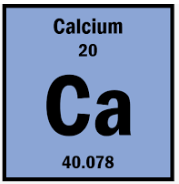
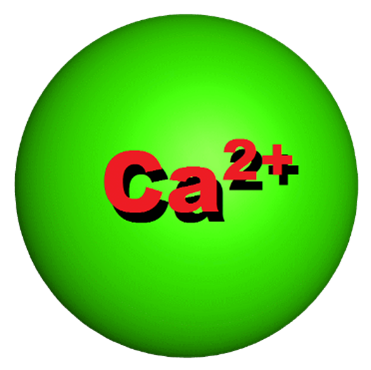
Calcium has an atomic number of 20 and is an alkaline earth metal. It is the fifth most abundant element in the earth’s crust and is found most often as calcium carbonate.  Calcium has many physical and chemical properties that make it one of the most essential minerals for life on this planet. It is very reactive with other chemicals and compounds and dissolves easily in water. When dissolved in water, calcium becomes a chemical ion that carries a strong +2 charge (Ca+2).  Because of this strong positive charge, calcium readily combines with other dissolved negatively charged ions like Carbonate (-2 CO3), Phosphate (-3 PO4), Chlorine (-CL), or a variety of protein ions. Because of this spontaneous reactivity, calcium becomes a very useful ingredient in many important biological functions.  An example is calcium’s use as an antacid.


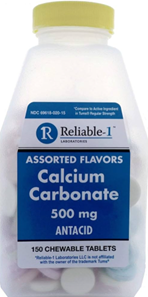
Calcium as an Antacid

Calcium compounds are often used to neutralize acids. For example, calcium-based antacids are the most common OTC remedy for acidy stomach complaints.  Forgive the simple analogy but taking calcium as an antacid is like a singles mixer party. Everyone leaves the date they came with to hang out with someone new. Stomach acid is primarily made up of the compound HCL and antacids are commonly made of Calcium Carbonate. (CaC03). The Calcium (Ca) in the antacid and Chlorine really want to stick to each other. That leaves the acid (H+) and the base (-CO3) to hang out with each other but they really don’t get along very well. Two of the Hydrogen ions steal away one of the Oxygens, and they turn into water (H2O). The leftover CO2 is disgusted with all the breakups and leaves the party as CO2 gas. That’s why you burp when you take an antacid.

Overall chemical reaction

CaCO3 (calcium carbonate) + 2HCl (hydrochloric acid) → CaCl2 (calcium chloride) + CO2 (carbon dioxide) + H2O (water)

Acid-Base Neutralization

 An Acidic solution is always a concentration of H+ ions. The more H+ ions the stronger the acid. A base always has the ability to give up an -OH ion. When -OH combines with the H+ it makes water. The acid and the base (caustic alkaline) have been neutralized. 


The Chemistry

It’s all about the charge. An ion is an atom or molecule with a net electrical charge. Calcium as an element has 20 positively charged protons but only 18 negatively charged electrons. That creates a strong +2 charge overall. When a molecule or other element that has an excess number of electrons comes close, they stick together like magnets and form a crystalline matrix. Following the antacid example above, A carbonate molecule (CO3) has 2 extra electrons, creating a -2 charge. When these two molecules come in contact with each other, they electronically stick together (opposites attract) and form CaCO3. A crystalline substance we know as chalk. When calcium is combined with an anion (a negatively charged ion) the resulting molecules are commonly called calcium salts.

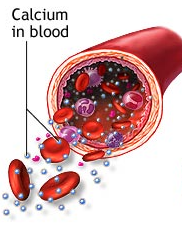
Water (H2O) on the other hand has a weak electric charge because of its V shape. It’s slightly positive on one side and slightly negative on the other. By itself, one molecule of water will not connect stick with either the Ca or the CO3 ion. But if there are a lot of water molecules, the combined partial charge becomes strong enough to pull the matrix apart. Thus, chalk dissolves in water and becomes ions. Now the Calcium and the Carbonate ions are free to be electronically attracted to other ions floating in the water. That’s why we call such ions electrolytes. Calcium is the most abundant mineral in the body. But only 1 % of it is floating around as an electrolyte. Most of the other 99% is locked away in the bones and teeth. More about the 1% later.


Calcium in Bones and Teeth

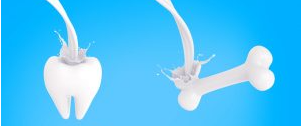
Bones and teeth are the hardest substances in our body. We need them to be hard to support all the work and movement we do. So how does an easily dissolvable chemical like calcium provide the support we need without falling apart? Our body combines calcium with other molecules of phosphates and oxides to form a hard-to-dissolve substance called Hydroxyapatite -Ca5(PO4)3(OH). To make it easier to read, I will refer to it as HA from now on. Our bodies take the HA and place it in a matrix surrounded by collagen. The matrix is now a hard yet flexible durable material that will not dissolve by itself or break easily. 65 to 70% of bone mass is HA. Bones are maintained by special cells called osteocytes. Some build up the bone matrix (osteoblasts). Others break down the matrix (osteoclasts). Thus, the bones become a bank account for calcium. When the body comes up short, it can pull it out of the bones.

In teeth, HA makes up 70 to 80% of the dental material. The tooth matrix is made up of HA, amelogenins, and enamelins instead of collagen. Teeth do not have maintenance cells. The acids and other materials in the food we eat and drink can leach out the Calcium and phosphates out of our teeth. The outermost layer is called enamel and is most suspectable to losing its minerals. Fortunately, we can remineralize the enamel with the use of dental preparations. If you include fluorine (like fluorinated water and toothpaste) fluorapatite is incorporated into the enamel instead of HA.  Fluorapatite -Ca5(PO4)3F is more resistant to acids than HA is, thus making stronger teeth. Do you see the difference? There is an F instead of an -OH. It will not react the same way with acids. Remember the -OH in the above acid-base reaction.


The Importance of the 1% of Calcium Electrolyte

Of all the calcium in our body only about 1% is floating about in our bodily fluids as an electrolyte. 1% doesn’t sound like much, but that small amount is essential to keeping us alive. Essential Functions of Calcium are:

  • It’s a second messenger in cell signaling pathways. (a cascade of events that triggers a certain action in the cell, in the nucleus, or in the cell membrane.
  • Plays a role in blood pressure regulation through constriction and relaxation of blood vessels (vasoconstriction and vasodilation)
  • It is involved with the electrical transmission in nerve signals.
  • Binding calcium ions to proteins creates hormones, enzymes, and various other essential compounds.
  • Calcium is involved in releasing the energy needed for muscles to work. That includes the heart muscles.
  • Mediates blood clotting


Calcium is incredible. In one way or the other, it has a major effect on every part of our body. However, all those beneficial actions will not happen correctly if the concentration of the free-floating Calcium ion is off.  The importance of having the right amount at the right time and in the right place throughout the body cannot be underestimated.

  • Too little calcium (hypocalcemia) and body parts won’t work. Calcium is so important that the body will pull it from the bones to get what it needs to function. Even if it makes the bones too weak themselves to function properly.
  • Too much calcium (hypercalcemia) and functions get messed up. The body will get rid of the excess to reduce the risk of metabolism failures. The surplus is excreted through the kidneys via the urine and through the intestine within the feces.
  • Even within the cells, calcium is strictly regulated.
    • The cell has specifically designed channels in the membrane that pump out calcium. (It wants to have more calcium on the outside in the interstitial fluid than on the inside.)
    • It also stores away calcium in vesicles to have a ready supply when needed.

So how does the body control the concentration of Calcium? Let’s take a look at the big picture.  


Control of the Concentration of Calcium

How does the body ensure the right amount of calcium is where it needs to be?  The short answer is a negative feedback loop involving parathyroid hormone (PTH), Calcitonin, and Vitamin D. More about that later, but first- let’s look at how we get calcium into our bodies in the first place. Our bodies cannot make calcium. We must get it from the foods we eat.  We chew up the food and mix it with liquids that contain digestive enzymes and stomach acids.  Remember how water breaks up calcium crystals and acids leach out the calcium ions. Now we have calcium ions floating around in broken-down food mash. The mash flows into the small intestine but the calcium ions can’t easily get into the cells lining the intestinal wall. Calcium needs some help getting past this barrier. That’s where Vitamin D gets involved. The active form of vitamin D (Calcitriol) stimulates the intestinal cells to make special channels in the cell membrane. These channels draw in the calcium from the gut. Then it passes through the cell and into the bloodstream.  Now the parathyroid hormone and Calcitonin take over. PTH facilitates calcium entering into cells and Calcitonin inhibits the process.

Now let’s get into the details. This is some of the advanced stuff I warned you about. To make it easier for you, I want you to watch a video. It was made to train nursing students. There will be a few exam questions about the information found in the YouTube video. Don’t worry though. They’re very easy questions to answer.


Calcium in Cellular Actions

We have been talking about the big picture. Now let us focus on the little picture. All the way down to the cellular level. The concentration of calcium ions is always greater on the outside of the cell. Why? Because calcium ions often act like the start button for cellular reactions. You only let the calcium in when you need that action to start. For example, 

 “Excitable cells, such as skeletal muscle and nerve cells, contain voltage-dependent calcium channels in their cell membranes that allow for rapid changes in calcium concentrations. For example, when a nerve impulse stimulates a muscle fiber to contract, calcium channels in the cell membrane open to allow calcium ions into the muscle cell. Within the cell, these calcium ions bind to activator proteins, which help release a flood of calcium ions from the storage vesicles of the endoplasmic reticulum (ER) inside the cell. The binding of calcium to the protein troponin-c initiates a series of steps that lead to muscle contraction. The binding of calcium to the protein calmodulin activates enzymes that break down muscle glycogen to provide energy for muscle contraction. Upon completion of the action, calcium is pumped outside the cell or into the ER until the next activation.”

Source:  https://lpi.oregonstate.edu/mic/minerals/calcium#osteoporosis-prevention

All of this action is driven by the strong +2 charge on the calcium ion. Like magnets, the ions are being pulled together or pushed apart by the ionic charge. This enables the calcium ions to:

  • Travel against the flow of fluids.
  • Move from areas of high concentrations to low concentrations.
  • Be connected to proteins, thus stabilizing them.
  • Fill cellular receptors (pushing the on button).

Unfortunately, cellular concentrations and ionic combinations are not all good news. Things can go wrong.

  • There are many calcium-dependent processes within the cell. If calcium concentrations remain too high in the cell for too long, all sorts of things go wrong, and the cell dies. That’s called cell apoptosis.
  • If Calcium, Vitamin D, or Parathyroid hormone levels get messed up, those things lead to Hypercalcemia and Hypocalcemia. Too much and too little calcium in the blood. Muscles don’t work right, nerves don’t fire well, constipation, etc…, not a very pleasant experience.
  • Also, the same ionic actions can lead to molecules that are unwanted. Calcium salts and HA crystals can build up in areas we don’t want them to be. Joints can become ossified, (become like bone), blood vessels can become hardened, and crystals can form in or on tumors, implanted medical devices, glands, and organs. An example is kidney stones. Brain structures can also collect crystals commonly known as brain sand.

To make it all simple. Controlling that 1% ionic calcium concentration is very important.

Well, that’s enough of that. Let’s talk about something more pleasant, FOOD.


Sources of Calcium

Healthy babies start out with about 26 to 30 grams of calcium. As the child grows the amount rises quickly. It peaks at about 1,200 g in women and 1,400 g in men by adulthood. Calcium levels remain constant in men, but they start to drop in women as a result of increases in bone remodeling. (During menopause, the loss of estrogen affects the action of bone maintenance cells, resulting in a net loss of HA.)  

So where does all that calcium come from? You know the answer- Food. In American diets, 75% of the calcium we take in comes from dairy products. 

Amounts of calcium in common foods

  • 8-ounce glass of milk = 300 mg
  • 8-ounce glass of calcium-fortified soy milk = 300 mg
  • 5 ounces of cheese = 300 mg
  • 6 ounces of yogurt = 300 mg
  • 3 ounces of sardines with bones = 300 mg
  • ½ cup of cooked turnip greens = 100 mg
  • ¼ cup of almonds = 100 mg
  • 1 cup of shredded bok choy = 74 mg
  • 1/4 cup of dried figs = 61 mg
  • 6 in. Corn tortilla = 46 mg
  • ½ pinto beans = 39 mg
  • ½ cup broccoli = 21mg


Calcium is a listed item in the nutritional Facts that are required on food packaged and sold in America. Consumers can see for themselves how much calcium is in the foods they eat.

Knowing which foods contain calcium and actually getting enough calcium inside you are two different things. It is a much more complicated process than what you might think. 

First: How much calcium is needed?

Dietary Reference Intakes for calcium:

  • Infants:

0 to 6 months: 200 milligrams per day (mg/day)

7 to 12 months: 260 mg/day

  • Children and adolescents:

Age 1 to 3: 700 mg/day

Age 4 to 8: 1,000 mg/day

Age 9 to 18: 1,300 mg/day

  • Adults:

Age 19 to 50: 1,000 mg/day

Age 51 to 70: Men - 1,000 mg/day; Women - 1,200 mg/day

Over age 70: 1,200 mg/day

  • Pregnancy and breastfeeding:

Age 14 to 18: 1,300 mg/day

Age 19 to 50: 1,000 mg/day

Source: https://medlineplus.gov/ency/article/002412.htm

Second: Not all foods have the same calcium bioavailability. 

The calcium is there in the food but it’s harder for the body to absorb it. Dairy is the best but-

 “The calcium content in calcium-rich plants in the kale family (broccoli, bok choy, cabbage, mustard, and turnip greens) is as bioavailable as that in milk; however, other plant-based foods contain components that inhibit the absorption of calcium. Oxalic acid, also known as oxalate, is the most potent inhibitor of calcium absorption and is found at high concentrations in spinach and rhubarb and somewhat lower concentrations in sweet potatoes and dried beans. Phytic acid (phytate) is a less potent inhibitor of calcium absorption than oxalate. Yeast possesses an enzyme (phytase) that breaks down phytate in grains during fermentation, lowering the phytate content of breads and other fermented foods. Only concentrated sources of phytate, such as wheat bran or dried beans, substantially reduce calcium absorption” Source: https://lpi.oregonstate.edu/mic/minerals/calcium#osteoporosis-prevention

Third: Vitamin D and other medicines affect how much calcium is absorbed leading to variability.

Fourth: Diets don’t exist in a bubble. What we eat on a consistent basis is influenced by several factors. Food allergies, taste preferences, cooking skills, food costs, culture, and even religion all determine what foods we consume. Wrapping a menu solely around the need for calcium is not very sustainable.

It is a small wonder that up to 46 % of Americans do not get the calcium they need in their diets. Many people turn to calcium supplements to make up the difference.  


How to get more Calcium

Getting more calcium to supplement the diet can be done in several different ways.

  • Calcium fortified food. Manufacturers of foodstuffs purposely add extra calcium to their products. For example- Wheat is not a good source of calcium, but Cream of Wheat in 1-1/4 cups of milk contains 630 mg (50% of the Recommended Daily Allowance (RDA) for calcium). Oats do not contain calcium but Cheerios in ¾ cup of skim milk contain 25% RDA.

  • Medical/Nutritional preparations contain calcium.

    Antacids

    • Tums Regular Strength: 200 mg of elemental calcium per tablet
    • Tums Extra Strength: 300 mg of elemental calcium per tablet
    • Tums Ultra Strength: 400 mg of elemental calcium per tablet

    Multivitamins 

    • Centrum Silver contains 230 mg of calcium per tablet.

    Meal replacement drinks.

    • Ensure Shakes contain 330 mg of calcium per dose.


  • Calcium Supplements

Calcium supplements come in many different formulations. They can be purchased as tablets, capsules, chews, liquids, and powders. Combined with Vitamin D and other minerals, (most often combined with Magnesium). They also come in a variety of different salts including calcium carbonate, calcium citrate, calcium citrate malate, calcium lactate, and calcium gluconate.


Calcium Supplements

Calcium preparations come in a great variety of choices. Choosing which is best depends on several different factors and is determined by the needs of the patient. The doctor knows this, but the details may get lost when considering all the other factors involved. You as the caregiver may have to point out the important details to the doctor or his staff.

Cost-

Calcium carbonate tablets are the least expensive formulation therefore the one preferred by insurance. To get a more expensive variety would have to be justified by patient circumstances.

Ease of Consumption-

Calcium is a bulky element. Putting enough calcium in each tablet makes them large and harder to swallow. If the patient has difficulty swallowing or refuses tablets then capsules, chews, liquids, or powders may be justified.

Side effects-

The main side effect of calcium is constipation. Adding magnesium which can cause diarrhea can help counteract constipation. Gas and bloating may also become an issue. Recall the calcium carbonate and acid reaction mentioned previously. Other calcium salts may have less gaseous effects.

Stomach Acid-

Calcium carbonate is dependent on stomach acid for absorption, Calcium Citrate and Calcium Malate do not. Conditions that affect stomach acid might justify the added cost of the citrate or malate. Those conditions include:

Chron’s disease, Irritable Bowel Syndrome

Naturally lower levels of stomach acid production (achlorhydria)

Chronic ulcers and or GERD that require acid blocker therapy

Excessive bloating

Vitamin D-

Adding vitamin D does not add much to the cost and is generally well accepted by insurance. Whether vitamin D is needed depends on the patient’s exposure to sunlight in sufficient quantities. The active form of Vitamin D is calcitriol (D3). Look for the D3 on the label.


When to take calcium for best results

Since calcium carbonate relies on acid, taking it with food or at mealtimes helps ensure the presence of stomach acid. In addition, only so much calcium can be absorbed at a given time. Excess amounts will just pass through and be excreted in the feces. It is recommended to take 500-600 mg from all sources at a time. This may require taking supplements twice daily.


When Things Go Wrong

Normally, In-Home caregivers don’t have to worry too much about calcium levels in their residents. Their bodies do a pretty good job taking care of themselves.  There are a few things that you do need to keep an eye on though. 

Osteoporosis

Adult Foster care clients are at greater risk of chronic bone loss that leads to fractures and broken bones. Sometimes the mere act of standing up will break a leg. Before they moved into your home there may have been years of poor calcium and bone maintenance. Not enough exercise to stimulate increased bone mass. Avoiding exposure to the sun leads to not enough vitamin D. Not enough Calcium in the diet. Chronic use of medications that interfere with calcium. Eventually, the resident is going to get overdrawn at the bone calcium bank. Fortunately, all you have to do is periodically ask the Doctor for a Bone density test for the resident. The doctor can take it from there.

Dehydration

The thirst drive in your residents, especially the elderly, may be reduced. This leads to chronic dehydration. If there is not enough water in the blood and tissues, ionic calcium can get messed up. Remember the water is what pulls apart the calcium salts. To keep an eye on things by looking at how dry and flakey the skin looks. You can also pinch the skin on the hand or arm. If it bounces back normally then you’re okay. If not---more water please.

Broken Control Mechanisms

Thyroid surgery, tumors, cancer, chronic intestinal problems like IBS, kidney disease, and blood pH problems can all interfere with calcium homeostasis. If your clients have any of these problems, ask the doctor to include a calcium blood test in the regularly scheduled exams.  You can also watch for the classic signs of blood calcium problems. Chronic constipation, slow muscle reactions, lower mental acuity, seizures, muscle twitches, abdominal pain, muscle cramps, tingling in the hands and feet, and changes in urination. If these become problematic, ask for that blood test.

Eating Disorders

Mental Health homes with eating disorder patients and Developmentally Disabled homes with extremely finicky eaters may have problems with  dietary calcium intake.

Drug Interference

Many drugs can interact with calcium. I’ll make this short and simple.

  • Thiazide diuretics (water pills like HTCZ) can cause the kidney to absorb more calcium back into the blood. Watch for hypercalcemia.
  • Lanoxin (digoxin) and calcium supplements can lead to heart arrhythmias.
  • Calcium may decrease the absorption of tetracycline, quinolone class antibiotics (Cipro), bisphosphonates (osteoporosis meds), sotalol (a β-blocker), and levothyroxine. You should separate them and calcium-rich foods and supplements by two hours at least.
  • Calcium supplements can decrease the effectiveness of some HIV drugs. Again, separate them by 2 hours.
  • H2 blockers (cimetidine) and proton-pump inhibitors (omeprazole) may decrease calcium absorption.
  • Lithium increases the risk of hypercalcemia.
  • Topical calcipotriene, a vitamin D analog, in the treatment of psoriasis may cause hypercalcemia. As what you might expect knowing what you know about vitamin D and calcium.
  • Magnesium has a connection with calcium. For example, too much magnesium (chronic Milk of Magnesium use) or low magnesium blood levels will mess with calcium concentrations.
  • Steroids and Corticosteroids when used chronically; like in some asthma inhalers (Flovent, Pulmicort) can lead to bone mass loss. No bone, no calcium bank.
  • You normally don’t have to worry about the calcium channel blocker class of high blood pressure medicine and calcium. The name might make you think otherwise but they are okay together.

There are computer programs that tell the doctor and the pharmacist that a drug interaction may occur. Drug interactions are not black and white though. There are a lot of other factors involved that determine if there is a risk for adverse events occurring.  The doctor and pharmacist know of the drug interactions but have determined that the benefits out way the risks. If harmful symptoms start occurring in the patient the doctor would probably alter the prescribed therapy. That is where you come in. You are the eyes and ears of the doctor. Watch for the classic calcium problem symptoms if your residents take any of the above meds. Then report them to the doctor promptly. Remember you don’t have to diagnose any of the problems above; you just have to suspect they are occurring. If nothing happens and the symptoms become problematic, then get the resident to the doctor and start asking the right questions.

  • Is this symptom a sign of a drug interaction between this med and that calcium source?
  • Does this problem that is cropping up outweigh the benefits?
  • This symptom is starting to be a real problem, is it time to consider altering the therapy?


 Cutting Edge Knowledge (Studies)

Medical research on the effects of calcium on the human body is ongoing. New hypotheses are always being explored. You as a medical care provider can be a part of that effort by observing and reporting on the things you see.

The following is more advanced stuff. If you have difficulty reading and understanding the material, it’s okay. There is only 1 easy exam question covering this material. It is kind of exciting though to be part of this work, even if it’s only a very small part.


Source for items in quotations.  Calcium | Linus Pauling Institute | Oregon State University

 Zinc

“Although high calcium intakes have not been associated with reduced zinc absorption or zinc nutritional status, an early study in 10 men and women found that 600 mg of calcium consumed with a meal halved the absorption of zinc from that meal”

Cardiovascular Disease

“Several observational studies and randomized controlled trials have raised concerns regarding the potential adverse effects of calcium supplements on cardiovascular risk. The analysis of data from the Kuopio Osteoporosis Risk Factor and Prevention (OSTPRE) prospective study found that users of calcium supplements amongst 10,555 Finnish women (ages 52-62 years) had a 14% greater risk of developing coronary artery disease compared to non-supplement users during a mean follow-up of 6.75 years. The prospective study of 23,980 participants (35-64 years old) of the Heidelberg cohort of the European Prospective Investigation into Cancer and Nutrition cohort (EPIC-Heidelberg) observed that supplemental calcium intake was positively associated with the risk of myocardial infarction (heart attack) but not with the risk of stroke or cardiovascular disease (CVD)-related mortality after a mean follow-up of 11 years (154). Yet, the use of calcium supplements (≥400 mg/day vs. 0 mg/day) was associated with an increased risk of CVD-related mortality in 219,059 men, but not in 169,170 women, included in the National Institute of Health (NIH)-AARP Diet and Health study and followed for a mean period of 12 years. CVD mortality in men was also found to be significantly higher with total (dietary plus supplemental) calcium intakes of 1,500 mg/day and above.”

Hypertension

“The relationship between calcium intake and blood pressure has been investigated extensively over the past decades. A meta-analysis of 23 large observational studies conducted in different populations worldwide found a reduction in systolic blood pressure of 0.34 millimeters of mercury (mm Hg) per 100 mg of calcium consumed daily and a reduction in diastolic blood pressure of 0.15 mm Hg per 100 mg calcium (113). In the DASH (Dietary Approaches to Stop Hypertension) study, 549 people were randomized to one of three diets for eight weeks: (1) a control diet that was low in fruit, vegetables, and dairy products; (2) a diet rich in fruit (~5 servings/day) and vegetables (~3 servings/day); and (3) a combination diet rich in fruit and vegetables, as well as low-fat dairy products (~3 servings/day) (114). The combination diet represented an increase of about 800 mg of calcium/day over the control and fruit/vegetable-rich diets for a total of about 1,200 mg of calcium/day. Overall, the reduction in systolic blood pressure was greater with the combination diet than with the fruit/vegetable diet or the control diet. Among participants diagnosed with hypertension, the combination diet reduced systolic blood pressure by 11.4 mm Hg and diastolic pressure by 5.5 mm Hg more than the control diet, while the reduction for the fruit/vegetable diet was 7.2 mm Hg for systolic and 2.8 mm Hg for diastolic blood pressure compared to the control diet. This research suggested that calcium intake at the recommended level (1,000-1,200 mg/day) may help prevent and treat moderate hypertension.

Yet, two large systematic reviews and meta-analyses of randomized controlled trials have examined the effect of calcium supplementation on blood pressure compared to placebo in either normotensive or hypertensive individuals (117, 118). Neither of the analyses reported any significant effect of supplemental calcium on blood pressure in normotensive subjects. A small but significant reduction in systolic blood pressure, but not in diastolic blood pressure, was reported in participants with hypertension. Of note, calcium supplementation in these randomized controlled trials ranged from 400 to 2,200 mg/day, with 1,000 to 1,500 mg/day being the more common dosages. A more recent meta-analysis of 13 randomized controlled studies in 485 individuals with elevated blood pressure found a significant reduction of 2.5 mm Hg in systolic blood pressure but no change in diastolic blood pressure with calcium supplementation (119). The modest effect of calcium on blood pressure needs to be confirmed in larger, high-quality, well-controlled trials before any recommendation is made regarding the management of hypertension. Finally, a review of the literature on the effect of high-calcium intake (dietary and supplemental) in postmenopausal women found either no reduction or mild and transient reductions in blood pressure.”

Premenstrual Syndrome (PMS)

“PMS refers to a cluster of symptoms, including but not limited to fatigue, irritability, moodiness/depression, fluid retention, and breast tenderness, that begins sometime after ovulation (mid-cycle) and subsides with the onset of menstruation (the monthly period) (100). A severe form of PMS called premenstrual dysphoric disorder (PMDD) has been described in 3%-8% of women of childbearing age. PMDD interferes with normal functioning, affecting daily activities and relationships.

Low dietary calcium intakes have been linked to PMS in early reports, and supplemental calcium has been shown to decrease symptom severity (102). A nested case-control study within the Nurses' Health Study II (NHS II) found that women in the highest quintile of dietary (but not supplemental) calcium intake (median of 1,283 mg/day) had a 30% lower risk of developing PMS compared to those in the lowest quintile (median of 529 mg/day). Similarly, women in the highest versus lowest quintile of skim or low-fat milk intake (≥4 servings/day vs. ≤1 serving/week) had a 46% lower risk of PMS. In a randomized, double-blind, placebo-controlled clinical trial of 466 women with moderate-to-severe premenstrual symptoms, supplemental calcium (1,200 mg/day) for three menstrual cycles was associated with a 48% reduction in total symptom scores, compared to a 30% reduction observed in the placebo group (104). Similar positive effects were reported in earlier double-blind, placebo-controlled, cross-over trials that administered 1,000 mg of calcium daily (105, 106). Recent small randomized controlled trials also reported that supplemental calcium (400-500 mg/day) for three weeks to three months reduced severity and/or frequency of symptoms in women with mild-to-moderate PMS (107-110). Currently available data indicate that daily calcium intakes from food and/or supplements may have therapeutic benefits in women diagnosed with PMS or PMDD.”


Conclusion

Are you as exhausted as I am? That was a lot of material that was covered. Who knew that simple calcium, the stuff that chalk and antacids are made of, is so important to the body?  It seemed that calcium affects just about everything. Hopefully, by conquering this advanced material you are now better prepared to be an advanced caregiver.

As always

Good Luck in your Caregiving Efforts

Mark Parkinson BsPharm


References:

  1. Calcium Fact Sheet for Health Professionals. National Institutes of Health (NIH) Office of Dietary Supplements. July 24, 2024. https://ods.od.nih.gov/factsheets/Calcium-HealthProfessional/
  2. Calcium Fact Sheet for Consumers. National Institutes of Health (NIH) Office of Dietary Supplements. Sept 14, 2023. https://ods.od.nih.gov/factsheets/Calcium-Consumer/#:~:text=Calcium%20is%20a%20mineral%20your,giving%20them%20structure%20and%20hardness.
  3. Calcium and calcium supplements: Achieving the right balance. MayoClininc.org. Nov. 01, 2022. https://www.mayoclinic.org/healthy-lifestyle/nutrition-and-healthy-eating/in-depth/calcium-supplements/art-20047097
  4. Calcium. Wikipedia, The Free Encyclopedia. Nov 14 2024. https://en.wikipedia.org/wiki/Calcium
  5. Calcium and Vitamin D. Bone Health and Osteoporosis.org 5/23/2023. https://www.bonehealthandosteoporosis.org/patients/treatment/calciumvitamin-d/
  6. Beth Kitchin. UAB Tone Your Bones: How Much Calcium Do I Need?. University of Alabama at Birmingham. Mar 31, 2020. https://www.youtube.com/watch?v=HgYsy6kh3eM&t=510s
  7. Calcium. Linus Pauling Institute, Oregon State University, Sept 2017. https://lpi.oregonstate.edu/mic/minerals/calcium#osteoporosis-prevention
  8. Calcium. Harvard T.H.Chan School of Public Health Mar 2023. https://nutritionsource.hsph.harvard.edu/calcium/
  9. Stephanie Watson. Calcium: What You Should Know. WebMD.com. Aug 21, 2024. https://www.webmd.com/vitamins-and-supplements/calcium
  10. Calcium. Mount Sinai.org. 2024. https://www.mountsinai.org/health-library/supplement/calcium
  11. Calcium. Wikipedia The Free Encyclopedia. Nov 14 2024. https://en.wikipedia.org/wiki/Calcium
  12. Hydroxyapatite. Wikipedia The Free Encyclopedia. Nov 30 2024.https://en.wikipedia.org/wiki/Hydroxyapatite
  13. Endocrinology | Parathyroid Gland | Calcitonin. Ninja Nerd. Medical Lecturers. May 11, 2017. https://www.youtube.com/watch?v=y64aXKCkHk4&t=299s
  14. Joanne Lewsley, et al. 7 Best Calcium Supplements for 2024. Medical News Today.com, Api 18, 2024. https://www.medicalnewstoday.com/articles/best-calcium-supplements#faq


Exam Portal

click on [Take Exam]

Purchase membership here to unlock Exam Portal.

*Important*

Registration and login is required to place your name on your CE Certificates and access your certificate history.

Username MUST be how you want your name on your CE Certificate.
What’s the Big Deal with Naloxone

(Opioid overdose kits)

Author: Mark Parkinson BsPharm:  President  AFC-CE

Credit Hours 1 - Approximate time required: 60 min.

Educational Goal

Instruct Adult Foster Care Providers on how to use the drug Naloxone for opiate overdose.

Educational Objectives

  • Tell why caregivers should care about Opioid Overdose.
  • Tell readers what Naloxone is.
  • Instruct how to use Naloxone for opioid overdose.
  • Provide additional information relevant to AFC providers about Naloxone.

Procedure:

Read the course materials.  2. Click on exam portal [Take Exam].  3. If you have not done so yet fill in Register form (username must be the name you want on your CE certificate).  4. Log in  5. Take exam.  6. Click on [Show Results] when done and follow the instructions that appear.  7. A score of 70% or better is considered passing and a Certificate of Completion will be generated for your records.

Disclaimer

 The information presented in this activity is not meant to serve as a guideline for patient management. All procedures, medications, or other courses of diagnosis or treatment discussed or suggested in this article should not be used by care providers without evaluation of their patients’ Doctor. Some conditions and possible contraindications may be of concern. All applicable manufacturers’ product information should be reviewed before use. The author and publisher of this continuing education program have made all reasonable efforts to ensure that all information contained herein is accurate in accordance with the latest available scientific knowledge at the time of acceptance for publication. Nutritional products discussed are not intended for the diagnosis, treatment, cure, or prevention of any disease.


This CE comes at the request of an AMH provider. (Yes, I do take requests.)

Opioid drugs are very beneficial in controlling major pain symptoms resulting from injury and disease. When administered under trained medical professionals' supervision, a lot of suffering can be alleviated. BUT there are some issues…… (Darn it all, why does there always have to be a But involved). Everyone’s got one and they’re often stinky.  Pardon the pun, I couldn’t resist.

Opioids are very powerful. Take too much at one time and you’ll stop breathing. Take too much over a long period of time and you will become dependent on them to feel normal. Take them to feel euphoria instead of for pain and you will become addicted. Darn it all….again. Why does the human animal always mess things up trying to seek pleasure? It seems to be a weakness we have. And you know that there will always be some bad guy willing to take advantage of that weakness to make a buck.

You might be thinking, “Yeah, I’ve heard of people overdosing on Opioids and dying. What’s that got to do with me? I’m a professional. I take good care of my residents, and I always follow the doctor’s orders. There will be no opioid overdoses in my home. So why should I care.”  A perfectly reasonable thought…… But, (there’s always a but)

  • Accidents happen. You can get distracted and hand the pain meds to the wrong person. The wrong person grabs the pain meds while your back is turned. The curious, mentally disabled, resident takes the meds of another.
  • There always seems to be a bad apple in the barrel. A co-worker or employee may not be as trustworthy as you are.
  • You are part of the larger professional health community. As part of the team, it falls on all of us to battle this epidemic that is causing so much harm.

All of these things have happened to me, as an In-home caregiver and as a pharmacist. So- yeah, you should care.

What’s that I hear? A grumbling “ok ok- I admit, I should care. Ya’ happy now….BUT….(snicker,) What can I do about it? ”  One word, Naloxone.


What is Naloxone?


That was a pretty good video….But, it misses some important points. Let me fill in the missing parts.

  • Naloxone has been shown to be safe and effective for over 50 years. It is so safe and effective that the federal government has made naloxone available over-the-counter at most pharmacies. Naloxone can be obtained without a prescription in 43 states, including Oregon.
  • The cost of OTC nasal spray is from 20 to 40 dollars and is available for purchase online. Some insurances may pay for OTC naloxone. You never know until you try. For example, use the Payflex card from Aetna Insurance at the cash register.
  • Naloxone can be used to determine how addicted someone is to opioids. It also can be used to reduce itching in some cancer therapies and chronic kidney disease.
  • Injectable versions act faster, I.V. versions in as little as 1 minute. The nasal spray is the easiest to use.
  • Approximately 25% to 40% of naloxone is eliminated as metabolites in urine within 6 hours post-administration, with up to 70% excreted within 72 hours. Patients with kidney problems slow down these excretion times.
  • Naloxone is used to get the overdosed victim breathing again. For those who are addicted to opioids, it can also trigger withdrawal symptoms. That could include severe headache, grouchiness, anxiety, vomiting, diarrhea, upset stomach, muscle pain, runny nose, and suicide ideation.


Suggestion for Adult Foster Care Use

In Foster Care Homes Naloxone would be used as a first aid response, so you would be covered by the first aid Good Sam laws. But….. (you’re probably getting tired of that joke). AFC homes have some guidelines for over-the-counter drugs that you must follow. To avoid all the hassles, I suggest the following.

  • Even though it is OTC, it would still be wise for Adult Foster Care providers to get a prescription for naloxone use from the primary care physician. I recommend having it as a standing PRN Doctor’s order, especially for Mental Health Homes and for all patients with a diagnosed substance use disorder.
  • If you intend to keep an emergency supply for first aid purposes it would be wise to get your county officials’ guidelines for its use in your home. Get approval from the county in writing to have it in your first aid kit before you buy it.
  • Internasal versions are easiest for AFC homes. Injectables require a nursing delegation and a sharps container.
  • Have naloxone administration training for each care staff member and document training completion.
  • Have a policy of always calling 911 when naloxone is used.
  • You have my permission to copy any part of this course to use in your training material.


How to use Naloxone

 I cannot do better than the Oregon State Public Health Divisions: Naloxone Training Protocol so I am including it in this course. For an original copy go to https://www.oregon.gov/oha/PH/PROVIDERPARTNERRESOURCES/EMSTRAUMASYSTEMS/Documents/naloxone-training-protocol.pdf

It comes complete with training completion documentation.

Quote

Opiate Overdose Treatment: Naloxone Training Protocol

        1. Signs and symptoms of opiate overdose

The signs and symptoms of opiate overdose include:

    • Unresponsiveness to yelling or stimulation, like rubbing your knuckles up and down the person’s sternum, or breastbone (also called a sternum rub) [This symptom effectively draws the line between overdosing and being really high but not overdosing.]
    • Slow, shallow, or no breathing
    • Pulse (heartbeat) is slow, erratic, or not there at all
    • Turning pale, blue or gray (especially lips and fingernails)
    • Snoring/gurgling/choking sounds
    • Body very limp
    • Vomiting

2. Opiate overdose treatment overview

    • Check for a response.
    • Call 911.
    • Start chest compressions.
    • Administer naloxone.
    • Resume chest compressions with rescue breathing if the person has not yet started breathing.
    • Conduct follow-up – administer a second dose of naloxone if no response after 3 minutes and resume chest compressions with rescue breathing.
    • If naloxone is administered, provide details to emergency medical services

3. Responding to an opiate overdose

    1. Check for responsiveness.
      • Yell.
      • Give a sternum rub. Make a fist and rake your knuckles hard up and down the front of the person’s sternum (breastbone). This is sometimes enough to wake the person up.
      • Check for breathing. See if the person’s chest rises and falls and put your ear near the person’s face to listen and feel for breaths.
      • If the person does not respond or is not breathing, proceed with the steps listed below.
    2. Call 911. If you have to leave the person, put the person in the recovery position.*
      • State that someone is unconscious due to suspected overdose and indicate if the person is not breathing. (If you call police or 911 to get help for someone having a drug overdose, Oregon’s Good Samaritan Law protects you from being arrested or prosecuted for drug-related charges or probation or parole violations based on information provided to emergency responders.)
      • Give the address and location.
      • Be aware that complications may arise in overdose cases. Naloxone only works on opiates, and the person may have overdosed on something else, e.g., alcohol or benzodiazepines. Emergency medical services are critical.

*Recovery position:

                1. Roll the person over slightly on the person’s side.
                2. Bend the top knee.
                3. Put the person’s top hand under the person’s head to support it.
                4. This position should keep the person from rolling onto his/her stomach or back, so the person does not choke if he/she vomits.


    1. (A) Start chest compressions with rescue breathing (CPR).
      • Place heel of one hand over center of person’s chest.
      • Place other hand on top of first hand, keeping elbows straight with shoulders directly above hands.
      • Use body weight to push straight down, at least 2 inches, at rate of 100 compressions per minute.
      • Give 2 breaths for every 30 compressions.
      • CPR should be performed for 5 rounds (2 breaths for every 30 compressions), or for approximately 2 minutes, before reassessing.

OR

(B) If overdose is witnessed, i.e., you see the person stop breathing, or you are sure it is overdose due to personal knowledge of the person or situation, you have the option to start rescue breathing. Be aware when you call 911 that they may instruct you to perform CPR as well.

      1. Check the person’s airway for obstructions and remove any obstructions that can be seen
      2. Tilt the person’s forehead back and lift chin – see diagram below.
      3. Pinch the person’s nose and give normal breaths – not quick and not overly powerful breaths.
      4. Give one breath every five seconds.
      5. Continue rescue breathing for approximately 30 seconds.

4. Administer naloxone.

If the patient has been receiving opioids, giving them naloxone may result in temporary withdrawal symptoms. This response can include abrupt waking up, vomiting, diarrhea, sweating, and agitated behavior. While these symptoms can be dramatic and unpleasant, they are not life threatening and will only last until the naloxone has worn off. See details about specific naloxone products below.

a) If your naloxone kit is a syringe set up to be given as a nasal (nose) spray:

        1. Pull or pry off both top and bottom covers on the syringe.
        2. Pry off the cap of the naloxone capsule.
        3. Grip the clear plastic wings.
        4. Screw the naloxone cartridge into the barrel of syringe.
        5. Insert white cone into nostril; give a short vigorous push on the end of the naloxone cartridge to spray naloxone into the nose: one half of the cartridge goes into each nostril.
        6. If minimal or no response in 3 minutes, then give a second dose.

b) If your naloxone kit is NARCAN® Nasal Spray:

        1. Peel back the package to remove the device
        2. Hold the nozzle between two fingers as shown in image below.
        3. Place the tip of the nozzle in either nostril until your fingers touch the bottom of the patient’s nose.
        4. Press the plunger firmly with thumb to release the dose into the patient’s nose.
        5. If minimal or no response in 3 minutes, then give a second dose.

c) If your naloxone kit is a syringe set up to be given as an injection into a muscle (intramuscular):

        1. Remove cap of the naloxone vial.
        2. Draw up 1mL of naloxone into a syringe. (Ideally, the needle size for an injection into the muscle is 1 to 1.5-inches long and 25-gauge width)
        3. If available, clean the area with an alcohol wipe before you inject.
        4. Inject into muscle in the upper arm, thigh, or buttocks.
        5. Insert the needle at a 90-degree angle to the skin and push in plunger.
        6. If minimal or no response in 3 minutes, then give a second dose.

d) If your Naloxone kit is an Evzio® Injectable Device:


5. Resume chest compressions with rescue breathing (or chest compressions only) if the person has not yet started breathing. Brain damage can occur after 3-5 minutes without oxygen. The naloxone may not kick in that quickly. You may have to perform CPR for the person until the naloxone takes effect or until emergency medical services arrive.

6.Conduct follow-up.

      1. Naloxone takes several minutes to kick in and wears off in 30-45 minutes. The person may go back into overdose after the naloxone wears off.
      2. It is recommended that you watch the person for at least an hour or until emergency medical services arrive, in case the person goes back into overdose.
      3. You may need to give the person more naloxone. Give a second dose if the person does not respond after 3 minutes.
      4. If an overdose victim revives, keep the person calm. Tell the person that drugs are still in his/her system and that the naloxone wears off in 30-45 minutes. (Recommend that the person seek medical attention and assist him/her if necessary.)
      5. Do not let the person use more opiates. The naloxone will block them and the person could overdose again after the naloxone wears off.

End Quote

Again pretty good training …….But, (you knew I was going to write but again didn't yah)

Let me fill in some important details for AFC homes

  • Because naloxone wears off before the drugs do, you have to monitor the patient for 6-12 hours after the first naloxone dose.
  • If you have to repeat the nasal spray use alternating nostrils.
  • How many doses of naloxone to be stored in your first aid kit depends how long it takes for 911 responders to get to you (more for very rural areas) and what illnesses your residents have. (more for substance use disorders).
  • Tell 911 that you have given naloxone.
  • Some nasal spray packages contain 2 doses.
  • Store at room temperature with your other medications.
  • Don’t forget to include the naloxone prescription on your MARS.
  • If you use it, chart it on the PRN log and record the event in the resident’s file.

For visual learners here is a video on nasal spray naloxone administration.

Conclusion

Hopefully you will never have to use this information, and never have hear another “but” joke…. But…. If you do have to save a life from an opioid overdose, then you got the basics down. If you do forget the details, you know you can always come back to this lesson to get the why fors, the how to use, and what AFC providers have to do on top of everything else.

As always, good luck in your caregiving efforts.

Mark Parkinson BsPharm


References:

  1. Matthew R. Jordan; et al. Naloxone Stat Pearls. National Library of Medicine. May 5, 2024. https://www.ncbi.nlm.nih.gov/books/NBK441910/
  2. How Naloxone Saves Lives in Opioid Overdose. National Library of Medicine. Jan 15, 2019. https://www.youtube.com/watch?v=cssRZEI9ujY
  3. Tapering off opioids: When and how. Mayo Clinic.org. Nov. 23, 2023 https://www.mayoclinic.org/diseases-conditions/prescription-drug-abuse/in-depth/tapering-off-opioids-when-and-how/art-20386036#:~:text=Symptoms%20of%20opioid%20withdrawal%20may,such%20as%20sadness%20and%20depression.
  1. Opiate Overdose Treatment: Naloxone Training Protocol. Oregon State Public Health Division EMS & Trauma Systems. Oct 6, 2017 https://www.oregon.gov/oha/PH/PROVIDERPARTNERRESOURCES/EMSTRAUMASYSTEMS/Documents/naloxone-training-protocol.pdf
  2. NARCAN Nasal Spray - How to use. canaPHEM, Nov 9, 2018 https://www.youtube.com/watch?v=WnjgrRNMfKM


Exam Portal

click on [Take Exam]

Purchase membership here to unlock Exam Portal.

*Important*

Registration and login is required to place your name on your CE Certificates and access your certificate history.

Username MUST be how you want your name on your CE Certificate.
 

Guest:  Purchase Exam
 Page 3 of 24 « 1  2  3  4  5 » ...  Last »